 English
 Español
 عربي
You're running a packaging line, and every sheet comes off the die-cutter with the blanks still tied to the waste matrix by tiny nicks. Someone has to break those nicks and pull the scrap away before the blanks move downstream. An Automatic Die Cutting & Waste Stripping Machine does both jobs in one pass, cutting the sheet and clearing the waste before the blanks reach the delivery pile. This article explains how the stripping unit breaks the nicks, what the heavy-duty frame contributes, and what to verify when you're specifying a combined die-cutter and stripper for carton or corrugated production.
How Does the Stripping Unit Break the Waste Free?
Top Pins, Bottom Support, and a Quick Punch
The stripping action happens after the die-cutting station. The sheet moves into the stripping unit, where a set of upper pins pushes down on the waste pieces while the lower tooling supports the blanks. The pins punch the waste out of the sheet in one quick stroke, and the scrap falls away into a collection bin.
Jiexiang's waste stripping unit uses horizontal fixed-position stripping with a progressively accelerated motion curve. That motion profile concentrates the punching force at the waste points, so the nicks break cleanly without distorting the blank edges. The simplified structure reduces the number of moving parts, which lowers maintenance and improves the repeatability of the stripping action.
Why the Waste Removal Rate Matters
A stripper that misses a nick leaves scrap attached to the blank. That scrap jams the folder-gluer, causes mis-feeds, or ends up in the finished carton. The stripping unit is designed to clear the waste completely in one pass, with a multi-stage system that combines ejector pins and support pins against customized stripping plates. The system pressure is zone-adjustable, and the waste removal rate exceeds 99.5%.
What Does the Heavy-Duty Frame Deliver at 300T and 650T?
QT600-7 Ductile Iron and a German Crankshaft
A combined die-cutter and stripper absorbs the shock of two operations per cycle. The frame has to resist deformation under that load, or the cutting and stripping stations drift out of alignment. The JX series uses QT600-7 ductile iron for all cast parts, with specially processed body walls for high strength and permanent deformation resistance.
The crankshaft is made from German nickel-chromium alloy steel, heat-treated for high precision and resistance to permanent deformation. That rigidity is what holds the ±0.1mm die-cutting and stripping accuracy across a full production run, even at the top of the speed range.
300T vs. 650T Pressure
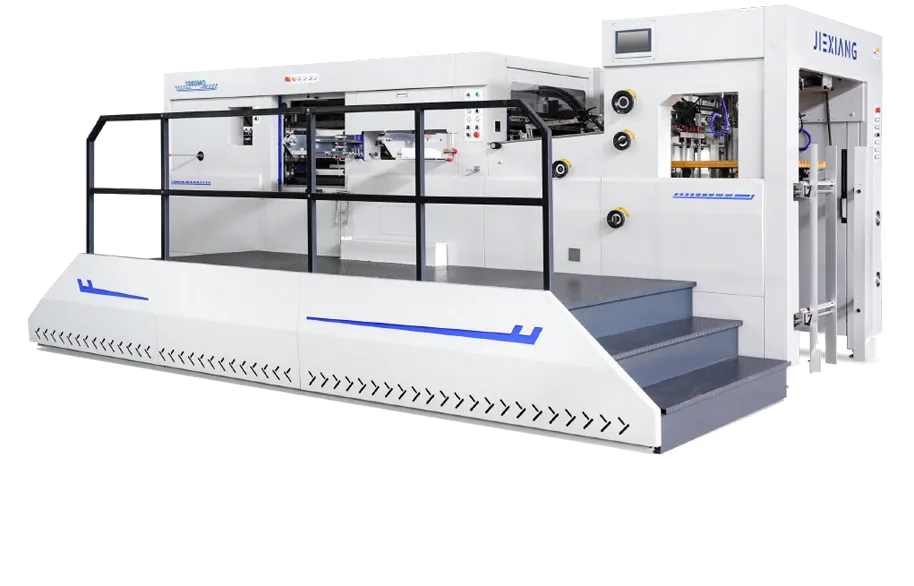
The JX-1060MQ carries a maximum working pressure of 300T, which covers folding carton board, fine corrugated, and plastic sheet up to the machine's thickness limits. The JX-1060MZQ raises the maximum pressure to 650T for heavier embossing or thicker material that needs more force to cut and strip cleanly.
| Parameter | JX-1060MQ | JX-1060MZQ |
|---|---|---|
| Max. feeding paper size | 1060×750mm | 1060×750mm |
| Min. feeding paper size | 390×320mm | 390×320mm |
| Max. die-cutting area | 1050×740mm | 1050×740mm |
| Paper specifications | 120–1500g/m² cardboard; corrugated ≤4mm | 120–1500g/m² cardboard; corrugated ≤4mm |
| Die-cutting & stripping precision | ≤±0.1mm | ≤±0.1mm |
| Max. working pressure | 300T | 650T |
| Max. working speed | 7,200 sheets/hour | 7,200 sheets/hour |
| Main motor power | 11kW | 18kW |
| Machine weight | 16T | 18T |
What Materials Run Through a Combined Die-Cutter?
The machine handles 120–1500g/m² cardboard, corrugated paper up to 4mm thick, and plastic sheet from 0.1–0.2mm. That range covers folding cartons, luxury wine boxes, high-end cigarette packaging, jigsaw puzzles, hang tags, and heavy-duty protective corrugated boxes. The material choice affects the stripping tooling. Thicker board and corrugated stock need more pin force and a different support plate layout than thin folding carton. The zone-adjustable stripping pressure lets the operator match the force to the material without changing the entire tooling set. Plastic sheet behaves differently again—it tends to spring back after cutting, so the stripping pins have to clear the waste before the sheet relaxes and traps it. Testing the actual material on the machine is the only reliable way to confirm the stripping parameters.
Where Does the Combined Design Change Production Flow?
Saves Space, Cost, Processes, and Time
A separate die-cutter and stripper occupy two footprints on the factory floor, consume two electrical feeds, and require an intermediate handling step between them. The combined design eliminates that second machine and the transfer between stations. Compared with separate machines, the integrated system saves floor space, lowers the initial investment and energy consumption, and removes the handling step that introduces damage and delay.
The efficiency gain is quantified at over 30% improvement in overall workflow. That improvement comes from the elimination of the second machine's setup, the removal of the transfer step, and the fact that the die-cutter and stripper run as one synchronized line rather than two independently paced machines.
Non-Stop Delivery and Quick Changeover
The delivery unit includes an automatic auxiliary delivery function for non-stop operation. While the main pile is being removed, the auxiliary system keeps the blanks flowing, so the machine doesn't have to stop for pile changes. The centerline positioning system and the automatic pressure adjustment system shorten job changeovers, and the modular quick-change design allows die and stripping unit changes in under 10 minutes.
A Automatic Die Cutting & Waste Stripping Machine like the JX-1060MQ from Jiexiang Machinery also includes a double-sheet detector, an automatic lubrication system with oil-pressure display and alarm, and a vacuum pump from German Becker for stable feeder transport. The machine is built for packaging converters who need to cut and strip in one continuous flow rather than managing two separate operations.
What Do Operators Ask About Combined Cutting and Stripping?
How does the stripping system ensure complete removal?
The patented multi-stage stripping system combines top ejector pins and bottom support pins with customized stripping plates. The system pressure is zone-adjustable, which lets the operator tune the force across different areas of the sheet. That combination achieves a waste removal rate of over 99.5%, so the blanks arrive at the delivery pile clean and ready for folding.
How quickly can I change over between jobs?
The centerline positioning system and the modular quick-change design reduce changeover time. Die and stripping unit changes can be completed in under 10 minutes, according to the manufacturer's specification. The smart memory function stores pressure and stripping parameters digitally, so switching between materials or jobs can recall pre-set values with one touch instead of manual adjustment.
What maintenance does the stripping unit need?
Inspect the stripping pins for wear or bending—a bent pin punches off-center and can damage the blank. Check the support plate for wear at the pin contact points. Verify the stripping pressure is consistent across the sheet width. The automatic lubrication system handles the main drive components, but the stripping unit's pneumatic components should be checked for air leaks and consistent response.
Can the machine run corrugated board?
Yes, up to 4mm thickness. The feeder head is designed for cardboard, corrugated paper, and gray board, with quad suction and quad feeding that adjusts to paper deformation. The stripping tooling may need different pin force and support plate configuration for corrugated than for folding carton, so confirm the tooling specification with the manufacturer for your specific board grade.
Let's Match a Combined Die-Cutter to Your Packaging Line
Share Your Material and Throughput Requirements
An Automatic Die Cutting & Waste Stripping Machine should match your material range, sheet size, and target output—not the other way around. The Full Automatic Heavy-duty Die-cutting and Waste Stripping Machine JX-1060MQ/MZQ from Jiexiang Machinery runs at 7,200 sheets/hour with ±0.1mm precision, handles 120–1500g/m² cardboard and corrugated up to 4mm, and clears waste in the same pass with a >99.5% removal rate. The JX-1060MQ delivers 300T working pressure; the JX-1060MZQ raises it to 650T for heavier embossing and thicker materials. If you're specifying a combined die-cutting and stripping line for folding cartons, corrugated boxes, or specialty packaging, send us your material and throughput requirements — we'll help you confirm the right model and tooling configuration before you order.