 English
 Español
 عربي
Yes—when the press is engineered for the load. An Automatic Foil Hot Stamping Machine built around a heavy-duty frame and a 40-ton pressure system can transfer foil onto cardboard up to 3,000 g/m² and grey board up to 3.0 mm thick, holding ±0.1 mm registration at speeds up to 1,500 sheets per hour. This article explains how the pressure system, the registration mechanics, and the foil feed work together on thick stock, and what to verify when you’re matching a heavy-duty press to rigid packaging production.
How Does a Heavy-Duty Press Deliver 40 Tons of Pressure?
The pressure system is the defining feature of a heavy-duty stamping press. A standard foil stamping machine might develop 20 tons of pressure—enough for folding carton and lightweight board. A heavy-duty model doubles that to 40 tons, which is the force required to press the heated die through the surface of a thick, dense substrate and transfer the foil across the full image area.
The pressure is generated through a crank-and-toggle mechanism driven by the main motor. The 7.5 kW main motor drives a crankshaft that converts rotary motion into the linear force of the platen. The crankshaft is machined from German nickel-chromium-molybdenum diamond steel, a material selected for its resistance to fatigue under the repeated 40-ton load cycles. A crankshaft that flexes or wears under that load would lose stamping pressure over time, and the foil transfer would become inconsistent.
The pressure is adjustable through an automatic pressure adjustment system, which lets the operator set the tonnage precisely for the substrate without stopping the press for manual shimming. That adjustability matters when a job mix includes both 1,500 g/m² folding carton and 3.0 mm grey board—the two materials need different pressure settings, and the transition between them should be a control parameter change, not a mechanical rebuild.
What Keeps Registration Accurate at 40 Tons?
Registration accuracy on a heavy-duty press depends on the machine’s structural rigidity as much as its optical alignment system. When the platen applies 40 tons, the frame deflects slightly. If that deflection is not controlled, the sheet shifts, and the foil lands off-target.
The machine uses imported Taiwanese ball screws for the feed mechanism, and the main servo includes overload protection. The timing belt carries a fracture protection circuit, and the machine halts automatically upon external impact to prevent damage to the body or the feeding accuracy. Those safeguards matter on a heavy stock line, where a mis-fed sheet that gets crushed under 40 tons can damage the die and the platen.
The registration tolerance is ≤±0.1 mm . That precision is held by the combination of the mechanical structure and the side gauge alignment. The side gauges use a Panasonic photoelectric system to detect the sheet edge and position it accurately before the stamping stroke. On thick board, the sheet has less flexibility to conform to the guides, so the alignment system has to be precise and the feed path has to be clear.
| Parameter | Heavy-Duty Sheet-Fed Press |
|---|---|
| Max. feeding paper size | 950 × 650 mm |
| Min. feeding paper size | 200 × 200 mm |
| Max. foil stamping size | 800 × 530 mm |
| Paper specifications | 128–3,000 g/m² cardboard; 3.0 mm grey board |
| Foil stamping precision | ≤±0.1 mm |
| Max. working pressure | 40 T |
| Max. working speed | 1,500 sheets/hour |
| Max. feed pile height | 600 mm |
| Max. foil length | 240 m |
| Foil width | 20–600 mm |
| Electric heating | 5 kW, 2 zones, 40–200°C |
| Main motor power | 7.5 kW |
| Full load power | 17 kW |
| Machine weight | 3,300 kg |
How Does the Foil Feed System Handle Thick Substrates?
Thick board requires a foil feed system that can advance the foil without stretching or misaligning it. The press uses a dual longitudinal foil feeding mechanism, equipped with Hangzhou Zhishan servo motors and a Xinje PLC control system. The mechanism is positioned behind the longitudinal foil feeding section to ensure smooth and flat foil collection after stamping.
The foil length is monitored by a computer-controlled system that displays the remaining and consumed foil length, and triggers an alarm when the foil drops below 10 cm. That monitoring prevents the press from running dry, which on a heavy-duty machine would mean stamping 40 tons of pressure onto a sheet with no foil to transfer—wasting the sheet, the die, and the production time.
Where Does a 40-Ton Press Fit in Packaging Production?
A heavy-duty sheet-fed press is built for rigid packaging—wine boxes, cosmetic gift boxes, luxury spirits cartons, and premium retail packaging that uses thick grey board or high-GSM cardboard. Those products need the metallic foil to sit flush on a dense surface, and a 20-ton press often struggles to achieve full transfer without multiple passes.
The heavy-duty press also serves puzzles, thick hang tags, and corrugated display headers where the substrate resists compression. In each case, the 40-ton capability is the difference between a foil image that transfers cleanly in one pass and one that requires a slower speed, a second hit, or a compromise on the die design.
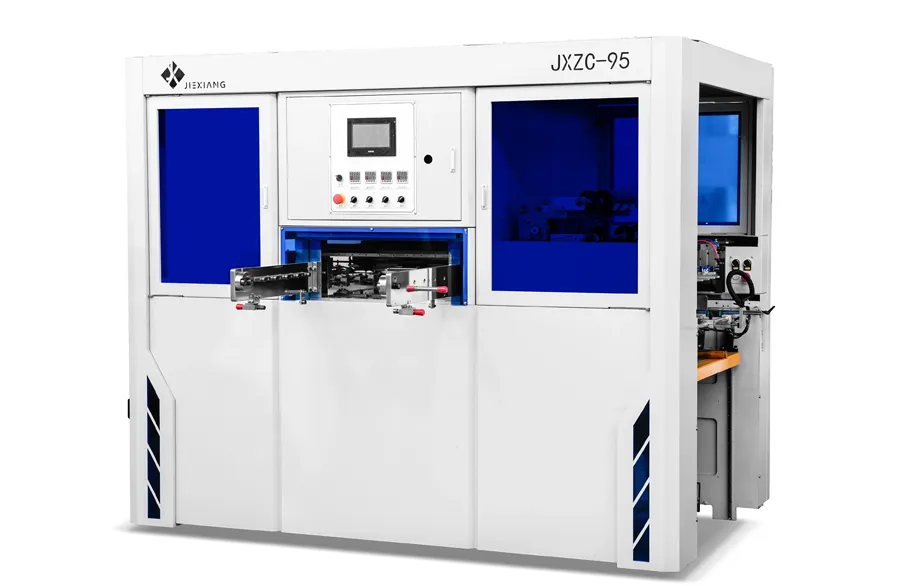
An Automatic Foil Hot Stamping Machine in the heavy-duty configuration from Jiexiang Machinery—the JXZC-95 model—delivers 40 tons of pressure at up to 1,500 sheets per hour, with ±0.1 mm registration and a 950×650 mm maximum sheet size. The machine is part of a broader range that includes the JX-1040C and JX-1060T platforms, covering both heavy-duty and high-speed production profiles.
What Should You Check Before Specifying a Heavy-Duty Press?
How do I match the pressure to my board thickness?
Check the maximum paper specification against your thickest substrate. The press handles 128–3,000 g/m² cardboard and 3.0 mm grey board. If your work includes thicker or denser material, confirm with the manufacturer whether a custom die or a higher-pressure configuration is required. The 40-ton rating is the ceiling, and running at the ceiling continuously leaves no margin for variation.
What heating configuration does thick board need?
The press uses 5 kW across 2 temperature zones, adjustable from 40–200°C. Thick board absorbs heat from the die, so the temperature recovery between cycles matters. If the die cools too much between impressions, the foil transfer becomes inconsistent. The two-zone control lets the operator compensate for edge cooling on a large die.
What maintenance does the 40-ton mechanism need?
Inspect the crankshaft and the toggle mechanism for wear during scheduled maintenance. The German nickel-chromium-molybdenum crankshaft resists fatigue, but the bearings and the linkage still need lubrication and clearance checks. Verify the ball screw and the feed timing belt for tension and alignment. Check the overload protection and the fracture detection circuit to confirm they trigger correctly under a simulated fault.
Straight Answers on Heavy-Duty Foil Stamping
What's the difference between a 20-ton and a 40-ton press?
A 20-ton press handles folding carton and lightweight board. A 40-ton press handles the same materials at a higher speed, and it also handles thick grey board and high-GSM stock that a 20-ton machine cannot transfer cleanly. The 40-ton machine has a heavier frame, a larger crankshaft, and a more robust feed system to support the higher load.
Can the press run at full speed on 3.0 mm grey board?
The maximum working speed is 1,500 sheets/hour, but the actual speed on 3.0 mm board depends on the die design, the foil type, and the dwell time required for full transfer. Thick board may run slower than the rated maximum to give the foil enough contact time under heat and pressure.
What foil width does the press accept?
The foil width range is 20–600 mm, and the maximum foil length is 240 m. The dual longitudinal feed mechanism reduces foil consumption and saves replacement time. For large solid areas on thick board, confirm that the foil width covers the image width plus the advance margin.
What happens if the foil runs out mid-run?
The computer-controlled monitoring system triggers an alarm when the foil drops below 10 cm. The press can be stopped, the foil replaced, and the run resumed. The alarm prevents the machine from continuing to cycle without foil, which would waste sheets and risk die damage under 40 tons of pressure.
Let's Match a Heavy-Duty Press to Your Rigid Packaging Line
Share Your Board Thickness and Foil Coverage
An Automatic Foil Hot Stamping Machine in the heavy-duty configuration should match your board thickness, foil coverage, and production speed—not the other way around. The Full Automatic Sheet-fed Heavy-duty Foil Stamping Machine from Jiexiang Machinery delivers 40 tons of pressure at up to 1,500 sheets/hour, handles 128–3,000 g/m² cardboard and 3.0 mm grey board, and holds ±0.1 mm registration with a 950×650 mm maximum sheet size. The German nickel-chromium-molybdenum crankshaft, Taiwanese ball screws, and Panasonic photoelectric side gauges support the mechanical and optical precision that thick-stock stamping demands. If you're specifying a press for wine boxes, cosmetic gift boxes, or premium retail packaging, send us your board thickness and foil coverage — we'll help you confirm the right configuration before you order.