 English
 Español
 عربي
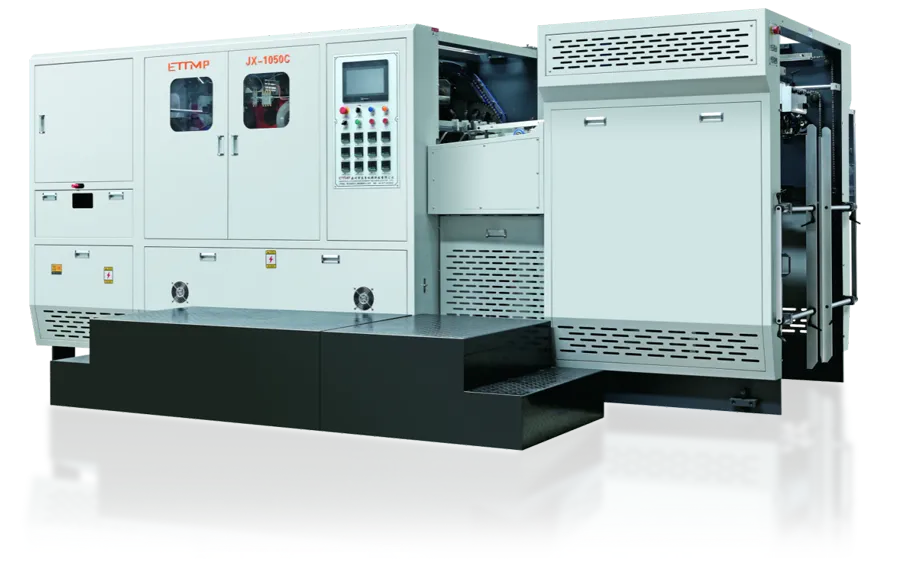
عربي You're producing wine boxes or cosmetic cartons where the metallic brand mark has to land with precision and the blank needs a clean die-cut edge. Traditionally, those two operations happen on separate machines — stamp first, stack, transfer, then die-cut. An Automatic Foil Hot Stamping Machine with an integrated cutting station changes that workflow. The JX-1040C from Jiexiang Machinery runs foil transfer and die-cutting in the same platen cycle at 4,800 sheets per hour with ±0.15mm accuracy. This article explains how the dual-function architecture works, what the pressure and heating systems deliver, and how to match the press to your packaging line.
What Happens Inside a Dual-Function Platen Press?
Two Closures, One Registration Reference
A flat-bed foil stamping press with integrated die-cutting performs two platen closures per sheet. The first closure presses the heated die against the foil and substrate, transferring the metallic layer. The sheet then advances a precise distance, and the second closure cuts the blank to its final shape, strips the waste, and ejects the finished piece.
The critical detail is that both operations share the same registration reference. There's no re-registration between stations, no handling step, and no opportunity for the stack to shift. The foil mark and the die-cut edge stay aligned because they're established in the same machine coordinate system.
Why Frame Material Determines Accuracy
A press that performs both stamping and die-cutting must absorb the mechanical shock of two closures per cycle without flexing. The JX-1040C uses a QT600-7 ductile iron frame — a material with nearly twice the tensile strength of grey cast iron — cast as a single monolithic unit rather than a welded assembly. The German nickel-chromium-molybdenum crankshaft resists permanent deformation under the 200T load, keeping the stroke length and pressure point consistent from the first sheet to the last.
That rigidity is what holds the ±0.15mm stamping accuracy across a full production run. Without it, the die would shift slightly with each cycle and the foil mark would drift off the cut line.
What Does 200 Tons of Pressure Actually Deliver?
Foil Release and Emboss Depth
Working pressure determines how completely the foil releases from its carrier and transfers to the substrate. At lower pressures, large solid areas and deep embossing come out patchy or silvered. The 200T working pressure on the JX-1040C applies enough force to fully transfer the foil across the 1010×720mm maximum stamping area, even on heavy cardstock and multi-level embossing dies.
The pressure is adjustable through a Jiexiang automatic pressure adjustment control device, which lets operators change settings quickly and precisely without stopping the press for manual adjustment.
Material Range and Sheet Handling
The press handles paper from 105-2000g/m² cardboard and corrugated paper up to 4mm thick. That range covers folding cartons, rigid gift boxes, wine and spirits cartons, cosmetic packaging, and display headers. Maximum feeding paper size is 1040×750mm, with a minimum of 400×320mm.
| Parameter | JX-1040C Specification |
|---|---|
| Max. feeding paper size | 1040×750mm |
| Min. feeding paper size | 400×320mm |
| Max. foil stamping area | 1010×720mm |
| Foil stamping precision | ≤±0.15mm |
| Max. working speed | 4,800 sheets/hour |
| Max. working pressure | 200T |
| Paper specifications | 105-2000g/m² cardboard; corrugated up to 4mm |
| Heating zones | 12 zones |
| Stamping temperature range | 0°-200°C |
| Foil shaft | 2V/3V |
| Main motor power | 7.5kW |
| Full load power | 34kW |
| Machine weight | 9T |
| Dimensions | 4600×2250×1900mm |
How Do 12 Heating Zones Keep Foil Transfer Even?
Independent Temperature Control Across the Platen
Heat loss at the edges of a large platen is one of the most common causes of inconsistent foil gloss. The center of the die runs hot while the edges run cool, and the cooler areas transfer less completely. The JX-1040C uses a 12-zone electric heating system adjustable from 0° to 200°C, with independent temperature control across the stamping area.
For a die that spans the full 1010×720mm area, the operator can set different temperatures for different sections of the platen. The center zone might run at 150°C while the edge zones run at 165°C to compensate for radiant heat loss. That zone-level control is what keeps the gloss uniform from one corner of the sheet to the other.
Foil Monitoring and Tension Control
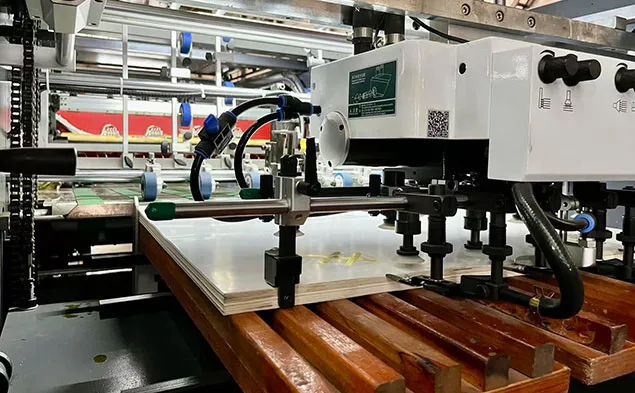
The foil feed system uses Inovance servo motors and an Inovance PLC control system. The vertical and horizontal foil feed mechanisms enable simultaneous foil stamping, which reduces foil usage and saves foil changing time. The vertical foil collection mechanism maintains tension through a hydraulic constant tension suspension system with ±0.5N fluctuation, paired with a maglev acceleration guide rail that reaches 120m/min in 0.2 seconds.
The computer-controlled foil monitoring system displays remaining and consumed foil length, and triggers an alarm when foil drops below 6cm, preventing the press from running dry and damaging the die or the paper.
Where Does Single-Pass Stamping and Cutting Fit?
Luxury Packaging and Premium Cartons
The JX-1040C serves applications where both foil stamping and die-cutting are required in one production flow. Wine boxes, spirits cartons, cosmetic packaging, and gift boxes demand flawless metallic finishes and precise die-cut shapes. In a conventional workflow, those stamped sheets would be stacked, moved to a die-cutter, loaded again, and run through a second press. Each transfer introduces handling risk — bent corners, misaligned stacks, surface scuffs on the foil.
The integrated station eliminates that transfer. The foiled surface never leaves the press until the blank is cut and ready for folding. For packaging where surface quality is paramount, removing the handling step removes a major source of defects.
Speed and Changeover for Mixed Production
The automatic feeder handles up to 4,800 sheets per hour with a double sheet detector and a non-stop paper delivery table. A centerline positioning system enables quick sheet changeovers, and the Sino-English touchscreen interface gives operators clear control over production parameters. The side gauges use a Panasonic photoelectric system for accurate sheet positioning, and the automatic oiling system with a cooling fan keeps the mechanism lubricated during long runs.
An Automatic Foil Hot Stamping Machine like the JX-1040C from Jiexiang Machinery combines the stamping and cutting steps into one machine, one setup, and one registration reference. The all-cast QT600-7 ductile iron frame and German nickel-chromium crankshaft support the 200T pressure system, and the imported components — Mueller, Omron, Schneider, Panasonic, and Taiwan Airtac pneumatics — keep the machine running smoothly through high-volume production.
What Should You Verify Before Specifying a Dual-Function Press?
How does the integrated die-cutting station affect floor space and labor?
Combining stamping and die-cutting into one machine removes the second press, the second setup, and the handling between operations. That reduces floor space consumption and shortens the production cycle from blank to finished product. Labor shifts from moving and loading stacks to monitoring one machine, which reduces the risk of handling damage.
What paper weights and thicknesses work on this press?
The JX-1040C handles 105-2000g/m² cardboard and corrugated paper up to 4mm thick. The maximum stamping area is 1010×720mm, so the die must fit within that window. For jobs that need a larger format or tighter accuracy, the JX-1060T and JX-1060TZ models deliver 7,500 sheets per hour with ±0.1mm accuracy.
How do I set the temperature for different substrates?
Start with the foil manufacturer's recommended range, then adjust based on the substrate. Thick cardstock and corrugated board need higher temperatures to drive the adhesive activation through the material. Thin paper runs cooler to prevent scorching. The 12-zone control lets you fine-tune the temperature profile across the platen, so you're not running the entire die at one setting when the edges need more heat.
What maintenance keeps the press running accurately?
Check the chain for wear — a stretched chain leads to positioning inaccuracy. Replace the engine oil on the standard schedule. Inspect the foil feed and collection mechanisms for tension consistency. The automatic oiling system handles routine lubrication, but the oil pump and cooling fan should be checked periodically. The double sheet detector and side gauge sensors should be cleaned and tested to maintain reliable feeding.
Let's Match a Foil Stamping Press to Your Packaging Line
Share Your Substrate and Design Requirements
An Automatic Foil Hot Stamping Machine should match your sheet size, substrate weight, and finishing requirements — not the other way around. The JX-1040C Fully Automatic Flat-bed Hot Foil Stamping Machine from Jiexiang Machinery runs at 4,800 sheets/hour with ±0.15mm foil stamping accuracy, handles paper from 105-2000g/m² and corrugated board up to 4mm, and integrates die-cutting into the same platen cycle. The 200T pressure system, 12-zone heating, and hydraulic foil tension control deliver consistent metallic finishes on luxury cartons, wine boxes, and cosmetic packaging. If you're specifying a foil stamping press for packaging production, send us your substrate and design details — we'll help you confirm the right configuration before you order.