 English
 Español
 عربي
Gold on a carton usually comes off one press, in one pass, at one temperature. An Automatic Foil Hot Stamping Machine feeds sheets one at a time, presses foil into the stock, and stacks them without an operator hovering over the delivery. Here's what the servo side of that actually changes, and what the numbers mean for your board.
Answers You'll Want Before Sending a Sample
What Stock Sizes Fit This Frame?
200×150mm at the small end, 600×500mm at the large end, with a stamping area up to 500×400mm inside it. Paper weight spans 128 g/m² through 3000 g/m² cardboard, plus 3.0mm grey board. That covers the everyday folding carton and the rigid box wrap a shop quotes in the same week, so one frame handles jobs you'd otherwise split across two suppliers.
How Tight Does Registration Actually Hold?
±0.1mm, quoted as a ceiling rather than a best case. Two details keep it there. An L-shaped right-angle push gauge squares a sheet against a known corner instead of trusting a straight edge, and a vacuum negative-pressure check stops the cycle when no sheet is present — the platen never fires into empty air and never leaves a ghost impression on the next sheet.
What Speed Should You Expect on the Floor?
1,800 sheets/hour is the top of the range, reached on lighter stock and short pulls. Heavier board and long foil pulls bring that number down, and no honest supplier should promise you the ceiling on 3mm grey board. Plan your quote on a realistic average, not the peak.
Where the Servo Drive Changes the Feel of the Run
Motion That Stops When Something Goes Wrong
A servo main drive on imported Taiwanese ball screws does more than move faster than a cam — it lets the frame react. The main servo carries overload protection, the timing belt has fracture protection, and the machine halts automatically if it takes an outside impact. That stop protects two things at once: the body and the feeding accuracy. You lose a handful of sheets instead of a platen, and you don't spend the afternoon re-setting registration from scratch. Genuine imported bearings under the main unit are what make that motion repeatable, which is a difference you notice at the end of an eight-hour run rather than in the first hundred sheets.
From Pile to Delivery Without a Hand in Between
Feeding, One Sheet at a Time
The feeder regulates speed through an advanced control system, and the separation section is cut from a special aluminum alloy so a sheet leaves the pile without dragging its neighbor along. Single-sheet feeding is the baseline here, not an upgrade. The suction paper row uses servo micro-adjustment, so an operator corrects pickup while the machine keeps running instead of stopping, walking in, and restarting the run.
A Stack That Comes Out Square
At the other end, a photoelectric sensor watches the receiving table and keeps the pile neat as it grows, and the table lifts automatically to hold a workable height. That matters more than it sounds: a delivery you don't have to unload mid-run is a delivery that keeps landing flat, which keeps the next operation — die cutting, folding, gluing — from starting with a crooked pile.
Heat, Pressure, and Foil in Three Moving Parts
Setting a Window Instead of a Number
Heating runs 4kW across 2 zones, adjustable from 40-200°C, so a large sheet can carry a cooler edge and a hotter center without one area going faint while the other burns. Working pressure reaches 20T, and an automatic pressure adjustment system lets you dial a new value in seconds rather than chasing it with a wrench between jobs. A parallel pressure adjustment device with a flat upper platform keeps the platen square to the sheet, which is the mechanical reason a logo doesn't come out half bright and half dull.
The Numbers Behind a 600×500 Sheet
Specs That Decide Whether Your Job Fits
Most of these figures describe limits rather than features: the largest sheet the feeder accepts, the heaviest board the platen presses, the widest foil the shaft carries. Read them against your own job list and the answer to "will this run my work" usually shows up in two lines.
Three of them matter more than the rest. Foil width of 20-600mm decides how many lanes you can pull at once. A foil capacity of 240m lengthwise sets how long you run before a roll change, and a 600mm pile height caps how much you can load in one go. Then check the supply: this frame runs on 1P/220V, which is worth confirming against your building before anything else is discussed.
| Parameter | Value |
|---|---|
| Model | JXZC-62 |
| Max. feeding paper size | 600×500 mm |
| Min. feeding paper size | 200×150 mm |
| Max. foil stamping size | 500×400 mm |
| Paper specifications | 128-3000 g/m² cardboard, 3.0 mm grey board |
| Foil stamping precision | ≤ ±0.1 mm |
| Max. working pressure | 20 T |
| Max. working speed | 1,800 sheets/hour |
| Max. feed pile height | 600 mm |
| Max. foil length | 240 m (lengthwise) |
| Electric heating | 4 kW, 2 zones, 40-200°C |
| Foil width | 20-600 mm |
| Main motor power | 3 kW |
| Full load power | 7 kW |
| Overall dimensions | 1800×1550×1800 mm |
| Machine weight | 1,000 kg |
| Working voltage | 1P/220V |
Hardware You Only Notice When It's Missing
Components, Foil Control, and the Add-On List
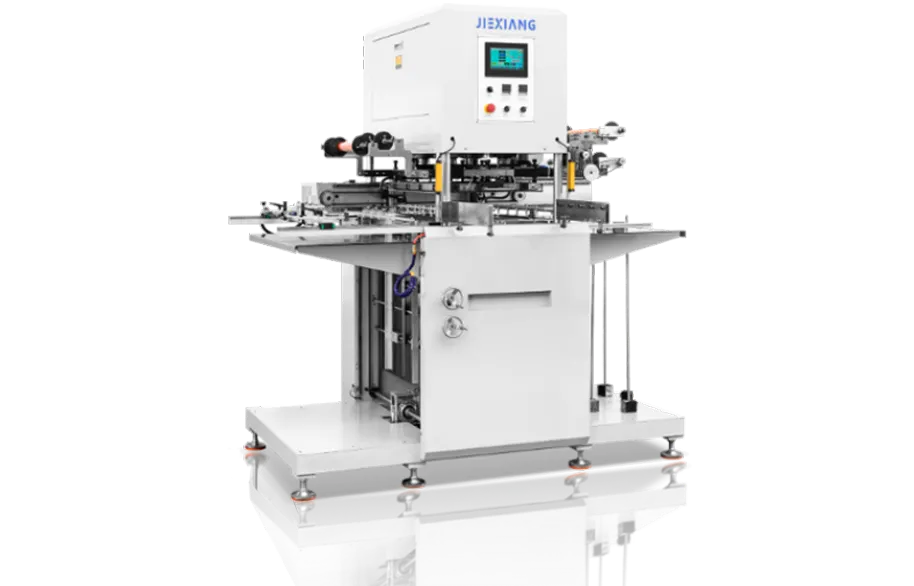
Jiexiang builds the Full Automatic Servo-driven Foil Stamping Machine on a Q235 carbon steel body whose wall panels get special processing for strength and for dimensional stability that holds under load. The parts deciding uptime are named rather than implied: Omron and Schneider electricals, AirTAC pneumatics on every air motion, SICK photoelectric sensors, and an Xinjie PLC running the sequence. The stamping plate is hard anodized, so it stays light enough to move fast and hard enough not to deform. Foil control is where the savings hide — a dual longitudinal foil feeding mechanism driven by Hangzhou Zhishan servos sits behind the main feed so spent foil collects flat, the computer displays both remaining and consumed length, and an alarm fires once usable foil drops below 10cm. Add a Sino-English touchscreen, independent manual control for setup, and an optional list you can specify down to the brand. Every Automatic Foil Hot Stamping Machine in this JX range carries that same foundation.
Optional component grades you can specify:
- Push buttons: Eaton (Germany)
- Circuit breakers, motor protectors, AC contactors, air circuit breakers: Schneider (France)
- Solenoid valves, air flow regulators, cylinders: AirTAC (Taiwan, China)
- Gripper bars and grippers: KUI (Japan)
- Photoelectric sensors: SICK (Germany); proximity sensors, encoders, counting sensors, intermediate relays: Omron (Japan); fiber optics: Panasonic (Japan)
Put Your Toughest Sheet on the Table
Send a Sample and a Daily Volume
The quickest route to a straight answer is a sample sheet: the board you actually run, the foil you actually buy, and the daily count you need to hit. Registration, heat, and pressure all get settled from those three things, not from a catalogue page.
Send that sheet through our request a quotation form and we'll come back with an Automatic Foil Hot Stamping Machine matched to your stock, your foil, and your volume — including which optional component grades are worth paying for on your floor.