 English
 Español
 عربي
An Automatic Foil Hot Stamping Machine earns its keep on packaging work where the foil has to land on the printed logo, not near it. You'll see what the register correction system actually compensates for, which mechanical components hold the accuracy, and where the paper and pressure limits sit.
What Does the Correction System Actually Adjust?
Is register correction just an optical alignment feature?
It's broader than that. The correction system compensates for variations in paper feeding, thermal expansion during hot stamping, and mechanical drift over long runs. An optical sensor alone can see that the foil is off-register, but it can't fix the three underlying causes. The correction system acts on the feeding mechanism and positioning references so the foil lands on the design sheet after sheet, not just on the first few.
Where does the L-shaped push gauge fit in?
The L-shaped right-angle push gauge is the paper-positioning reference. It makes paper positioning more accurate and meets different printing register requirements. On a printed carton, the gauge registers the sheet against a fixed datum, and the correction system works from that datum to place the foil. Without a repeatable paper position, the correction system would be chasing a moving target.
The Mechanical Chain Behind ±0.1mm
Accuracy at ±0.1mm isn't a single feature; it's the sum of several mechanical decisions. The frame is Q235 carbon steel, with body wall panels specially processed for high strength and permanent dimensional stability. A frame that flexes under stamping pressure would move the registration reference with it, so the structural rigidity is part of the accuracy story.
The main spindle is driven by a 1.5KW servo motor, and the four-column structural design keeps the hot stamping stable and less prone to tilting. The spindle core reaches a high-frequency quenching depth of 0.5mm and is hard-chromium plated, which addresses wear at the point where the stamping motion repeats thousands of times per shift. Imported Taiwanese ball screws handle the precise movement, and the main unit uses imported genuine bearings. Those are the components that turn a command from the control system into a repeatable mechanical position.
Why the paper transfer drive matters for register
The horizontal paper feeding device uses servo motor control. A servo-driven feed lets the control system adjust the sheet's arrival position in real time, which is exactly what the correction system needs to compensate for feeding variation. If the feed were a fixed mechanical drive, the correction system would have no actuator to work with—it could detect drift but not correct it.
Speed, Pressure, and the Paper Envelope
The page lists a maximum mechanical speed of 2,000 sheets/hour and a foil stamping accuracy of ±0.1mm, while the feature summary cites a maximum speed of 1,800 sheets/hour. The blog article on register correction also references 1,800 sheets/hour as the speed at which ±0.1mm is held. In practice, the 1,800 figure is the production reference for accuracy-critical work, and the 2,000 figure is the mechanical ceiling.
| Parameter | JXC-58 specification |
|---|---|
| Max. paper-feeding area | 580 × 450mm |
| Min. paper-feeding area | 100 × 100mm |
| Max. hot stamping area | 300 × 250mm |
| Max. mechanical speed | 2,000 sheets/hour |
| Foil stamping accuracy | ±0.1mm |
| Max. feeding pile height | 450mm |
| Total power | 3.5KW |
| Machine pressure | 1.5T |
| Overall dimension | 1500 × 1220 × 1650mm |
| Total weight | 650kg |
The pressure figure of 1.5T is the machine-level rating on this model. The blog article discusses a 20-ton configuration for heavy cardstock and greyboard up to 3.0mm, which sits in a different model tier. For the JXC-58, the 1.5T rating and the 580×450mm sheet size define the working envelope.
What the paper size range covers
The maximum feeding area of 580×450mm and the minimum of 100×100mm span small labels through mid-size carton blanks. The max hot stamping area of 300×250mm is the zone where foil can be applied in a single impression—larger designs require multiple hits or a larger model. Matching the design to that stamping area is the first check before specifying the machine.
Feeding and Delivery: Where Drift Starts
Register drift often begins at the sheet edges. The paper feeding table is stainless steel, and the lifting system is driven by a stepper motor. The front triangular aluminum guides are fixed on both sides, while the rear paper stop bar adjusts in multiple directions to accommodate different paper types. An air-blowing device at the front section separates sheets and prevents double feeding.
-
Front guides: fixed triangular aluminum, both sides
-
Rear stop bar: multi-directional adjustment for different stocks
-
Air blow: sheet separation to prevent doubles
-
Feed drive: servo motor on the horizontal transfer
-
Delivery table: stainless steel, stepper-driven lift
Why double-sheet prevention is a register issue
A double feed changes the stack height at the stamping station and shifts the sheet's position relative to the gauge. Even a fraction of a millimeter of stack-height variation can move the foil landing point. The air-blowing device and the fixed front guides work together to present one sheet at a time in a consistent position—which is what the correction system needs to do its job.
Control, Safety, and the Component Set
The control architecture uses a Sino-English touchscreen interface, a Xinjie PLC, and a computer processing foil monitoring system that displays remaining and used foil lengths. The foil monitoring system triggers an alarm if the foil length falls below 10cm. That's a practical detail for a production run: a foil run-out mid-job creates a gap in the stamped sequence, and the alarm gives the operator time to splice or replace the roll before the gap reaches the delivery.
The component list reads as a specification for uptime: Omron and Schneider electrical parts, AirTAC pneumatic components, SICK photoelectric sensors, and Taiwanese ball screws and AirTAC cylinders. A safety protection grating stops the machine and sounds an alarm if an object approaches during operation.
What the foil monitoring system prevents
A foil monitoring system that displays used and remaining length is a register safeguard, not just a convenience. When the foil runs out, the stamping continues without foil transfer, producing unstamped sheets that look identical to stamped ones on a fast-moving delivery pile. The alarm at 10cm remaining gives the operator a window to act before that happens.
Where the JXC-58 Fits Precision Packaging Work
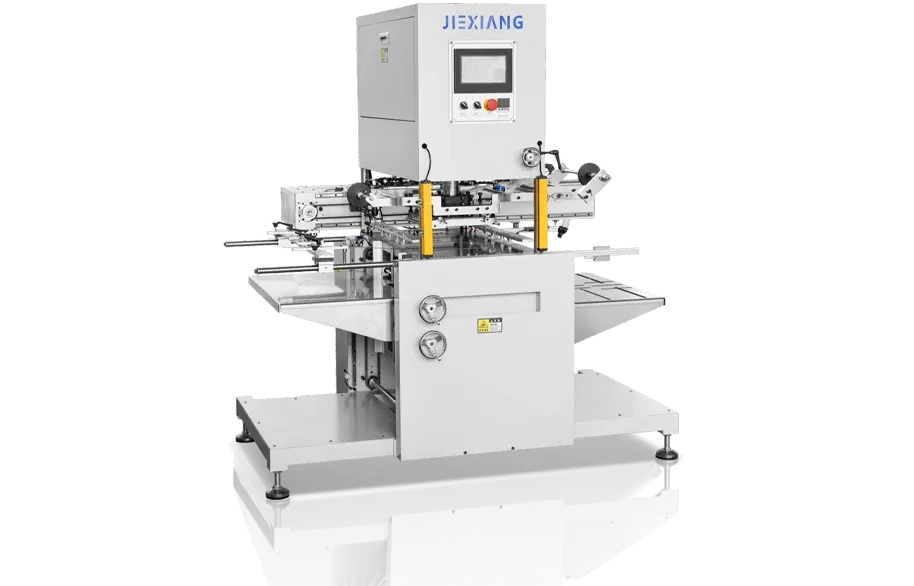
The Fully Automatic Hot Stamping Machine with Register Correction System from Jiexiang Machinery is built around the accuracy requirement the page and its companion article describe: ±0.1mm foil placement held across a run, not just at startup. The JXC-58 pairs an L-shaped right-angle push gauge with servo-driven paper feeding, a four-column stamping structure, and a Q235 steel frame processed for dimensional stability. The component set—Xinjie PLC, Omron and Schneider electricals, SICK sensors, AirTAC pneumatics, Taiwanese ball screws—gives the correction system a stable mechanical and control platform to act on. For a converter running luxury cartons, cosmetic boxes, or premium labels where a fraction of a millimeter of drift is visible, that combination is what turns an Automatic Foil Hot Stamping Machine from a stamper into a register-holding production tool.
What to confirm before matching a job to the machine
Confirm the design's foil area against the 300×250mm max stamping area, the sheet size against the 580×450mm max feeding area, and the stock weight against the machine's pressure rating. The ±0.1mm accuracy figure is a machine-level specification—the paper, foil, and stamping conditions on your job will determine whether it holds in production. A trial on the actual stock is the step that confirms the register correction system is working with your material, not just the page's numbers.
Let's Check Your Foil Area and Sheet Size
Send over your stamping area, sheet dimensions, and target run speed—we'll help you check them against the JXC-58's 300×250mm foil zone, 580×450mm sheet capacity, and ±0.1mm register. Talk to Jiexiang Machinery about your Automatic Foil Hot Stamping Machine requirements and get a specification-level answer before you commit to the line.