 English
 Español
 عربي
An Automatic Foil Hot Stamping Machine running at 4,800 sheets per hour is stamping more than one sheet per second. At that rate, the foil has to land on the printed design on every sheet, and the machine has to return to the same position after every cycle. You'll see what holds that registration, how the frame and the indexing mechanism contribute, and where the sheet size and pressure envelope sits.
What Questions Come Up Before Stamping at 4,800 Sheets/Hour?
What does the indexing mechanism have to do with registration?
The Taiwan-imported indexing mechanism drives the gripper bars that carry the sheet from station to station. If that indexing has any play or drift, the sheet arrives at the stamping station slightly off-position, and the foil lands off the design. The page lists the indexing mechanism as precisely manufactured, with overload protection and gripper bar groove protection that automatically disengages and stops on impact. That protection is what prevents a jam from damaging the indexing accuracy—a mechanism that survives an impact without deforming keeps its register.
Why does the frame material matter for a stamping press?
The page lists all cast parts as ductile iron QT600-7, with machine body walls specially processed for high strength, permanent deformation resistance, and structural safety. A stamping press at 200T working pressure flexes its frame slightly on every cycle. If that flex isn't elastic—if the frame takes a permanent set over time—the stamping geometry changes and the registration drifts. Ductile iron QT600-7 is specified for the combination of strength and resistance to permanent deformation.
The Registration Chain: Feeder, Gauges, and Foil Control
Registration starts at the feeder. The page describes a precision feeder head suited to cardboard, corrugated paper, and gray board, with quad suction and quad feeding, adjustable suction angle and height, and dual feeder head collision detection. The front and side gauges then position the sheet: front guide detection confirms the paper position, and a dual left-right push-pull guide method satisfies different printing registration requirements.
The foil side has its own control. The computer-controlled foil monitoring system displays remaining and consumed foil length, and the page notes an alarm if the foil length falls below 6 cm. The touch interface allows configuration of different long and short pulls, which is how the foil feed is matched to the stamping layout.
| Parameter | JX-1040C (from the product page) |
|---|---|
| Max. feeding size | 1040×750mm |
| Min. feeding size | 400×320mm |
| Max. stamping area | 1010×720mm |
| Gripper margin | 8–17mm |
| Paper specification | 105–2000g/m², corrugated ≤4mm |
| Stamping precision | ≤±0.15mm |
| Max. working pressure | 200T |
| Max. speed | 4,800 sheets/hour |
| Foil width | 20–1000mm |
| Heating | 12 zones, 40–200°C |
| Main motor | 7.5kW |
| Full load power | 34kW |
| Machine weight | 9,000kg |
Why the gripper margin range is 8–17mm
The gripper margin is the strip at the leading edge of the sheet that the gripper bars hold. It can't carry stamped product. An 8mm margin uses less of the sheet but demands tighter gripper control; a 17mm margin is more forgiving but wastes more area. On a 1040×750mm sheet, the margin choice affects how much saleable area the layout has—which is why it's specified alongside the stamping area.
Pressure, Temperature, and the Stamping Conditions
The maximum working pressure is 200T, and the maximum stamping area is 1010×720mm. The page lists Jiexiang's automatic pressure adjustment system for swift and precise stamping pressure control. That system matters when the job changes: a different board weight or a different foil needs a different pressure, and an automatic adjustment shortens the setup compared with manual pressure tuning.
The heating system uses 12 temperature zones, adjustable from 40–200°C. Multiple zones let the platen hold a uniform temperature across its area rather than a single element heating the whole plate unevenly. For a large stamping area, that uniformity is what keeps the foil transfer consistent from the center to the edges.
-
Pressure: 200T maximum, automatic adjustment system
-
Temperature: 12 zones, 40–200°C
-
Stamping area: 1010×720mm
-
Foil width: 20–1000mm
-
Foil length: up to 480m
-
Heating: electric, zoned
Why the crankshaft material is listed as a feature
The page specifies the crankshaft as made of German nickel-chromium alloy steel, offering high precision and permanent deformation resistance. The crankshaft converts the motor's rotation into the stamping motion, and it carries the full 200T load on every cycle. A crankshaft that deflects or takes a set changes the stamping geometry—the same reason the frame is specified in ductile iron. The two components together define how consistently the press delivers its pressure.
The Feeder and Delivery: Where the Sheet Enters and Exits
The feeder is listed as European-technology manufactured, with quad suction and quad feeding, an adjustable suction angle and height for paper deformation, and a unique paper transfer mechanism that adapts to variably distorted sheets. The page also lists non-stop switching between main and auxiliary feeding, with an optional pre-code paper mechanism.
At the delivery end, the page lists an automatic paper aligner and dual-path air blowing device for neat stacking of both thick and thin paper, photoelectric detection at the delivery, an automatic lifting/lowering control system for the delivery pile, a main chain protection device, and an anti-paper-retraction device. The delivery unit also carries an automatic auxiliary delivery function for non-stop operation.
-
Feeder: quad suction, quad feed, adjustable angle and height
-
Main/auxiliary feed: non-stop switching
-
Delivery: automatic aligner, dual-path air blow
-
Pile control: automatic lifting and lowering
-
Non-stop delivery: auxiliary delivery function
-
Delivery touchscreen: 10.4-inch, controls the whole machine
[H3] Why non-stop feeding and delivery matter at this speed
At 4,800 sheets per hour, a pile change is a production event. The page lists non-stop switching between main and auxiliary feeding, and an automatic auxiliary delivery function for non-stop operation. Together, those two functions let the press keep running while a new feeder pile is staged and a full delivery pile is removed—which is what makes the 4,800 sheets/hour figure achievable across a shift rather than only between pile changes.
Where the JX-1040C Fits a Stamping Shop
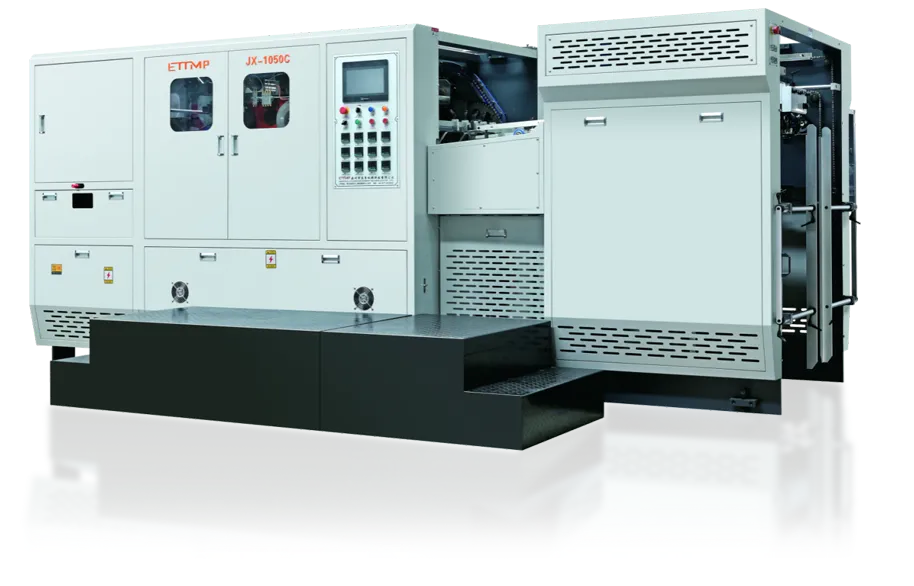
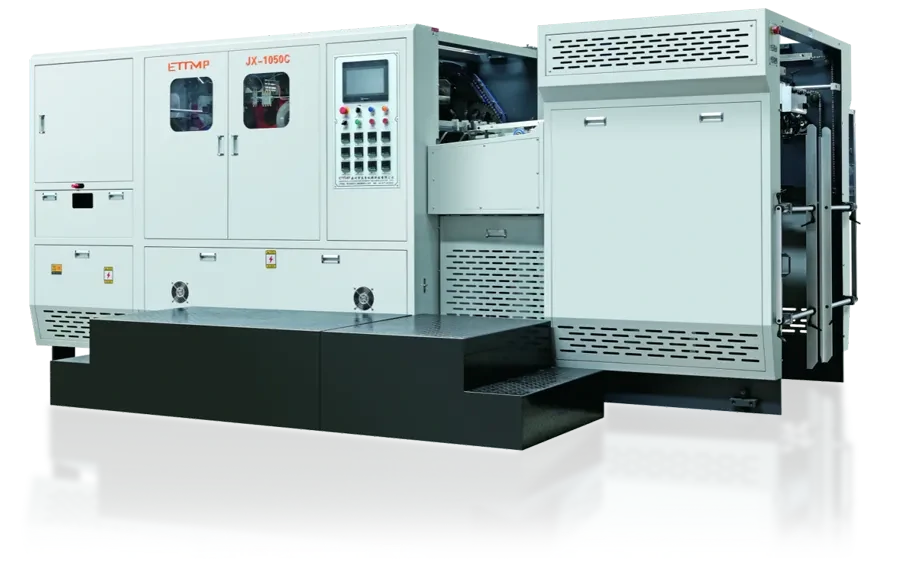
The Automatic Foil Hot Stamping Machine JX-1040C from Jiexiang is built around the registration chain the page describes: a ductile iron QT600-7 frame, a Taiwan indexing mechanism with impact protection, front and side gauges with front guide detection, and computer-controlled foil monitoring, all holding ±0.15mm at up to 4,800 sheets/hour across a 1040×750mm sheet and 105–2000g/m² board. The 200T pressure, 12-zone heating, and non-stop feeding and delivery support continuous production. For a stamping shop running packaging, cartons, and premium print, the value sits in the frame and indexing stability—the press returns to the same position after every cycle, so the foil lands on the design at the top of the speed range rather than only at a reduced trial speed.
What to confirm before matching a job to the JX-1040C
Confirm the sheet size against the 1040×750mm maximum and 400×320mm minimum, the board against the 105–2000g/m² and 4mm corrugated limits, and the stamping area against the 1010×720mm maximum. Check the foil width against the 20–1000mm range and the gripper margin against the 8–17mm specification. The page's parameters give the starting point; the actual board and foil determine the pressure and temperature settings.
Let's Match a Stamping Job to the JX-1040C
Send over your sheet size, board weight, stamping area, and target output—we'll help you check them against the 1040×750mm sheet, the 200T pressure, and the 4,800 sheets/hour speed envelope. Talk to Jiexiang about your Automatic Foil Hot Stamping Machine requirements and get a specification-level answer before you commit to the press.