 English
 Español
You‘re running a hot stamping job on a luxury carton. The foil needs to land exactly on the embossed logo — not a millimeter off. The print registration is tight. The customer expects perfection. And the machine you’re using drifts after a few hundred sheets.
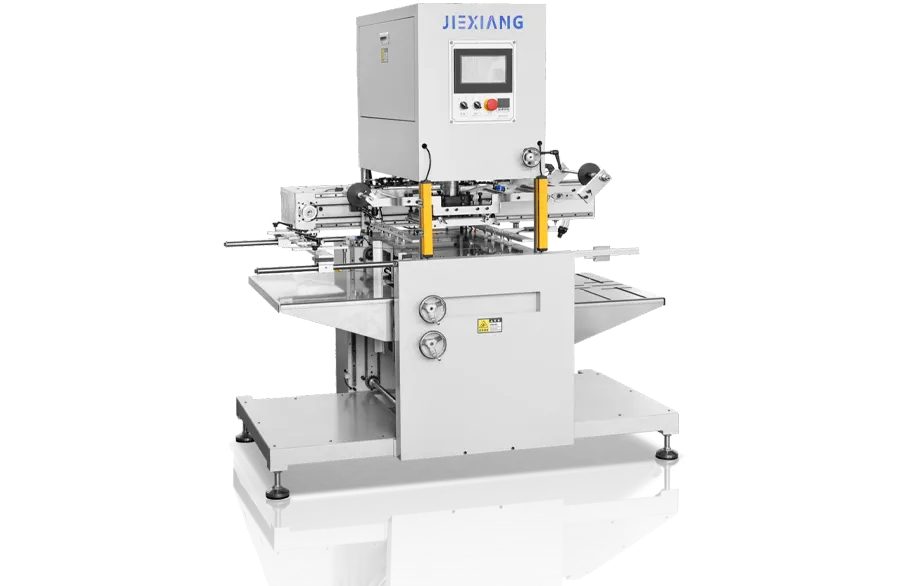
That‘s where a register correction system changes everything. An automatic foil hot stamping machine equipped with this feature doesn’t just stamp foil — it keeps the foil in perfect register with the printed design, sheet after sheet, shift after shift. The JXC-58 model takes this capability seriously, with ±0.1mm foil stamping accuracy and an L-shaped right-angle push gauge that makes paper positioning more accurate and meets different printing register requirements. This guide explains what register correction actually does, how it works, and why it‘s non-negotiable for high-value packaging work.
Keeping foil exactly where it should be
Register correction is about one thing: making sure the foil lands exactly where the design requires it — every single time.
What register drift actually costs you
When foil drifts off register, the result is rejected sheets, wasted material, and unhappy customers. On a luxury packaging job — perfume cartons, cosmetic boxes, premium labels — even 0.2mm of drift is visible. A register correction system holds foil stamping accuracy to ≤±0.1mm. That‘s the difference between a carton that passes inspection and one that gets scrapped.
How ≤±0.1mm accuracy is achieved
A high-performance register correction system combines several precision components. The machine uses an L-shaped right-angle push gauge to make paper positioning more accurate and meet different printing register requirements. The four-column structural design makes hot stamping more stable and less prone to tilting. Precision ball screws ensure accurate movement. And the main spindle is driven by a servo motor, with the spindle core undergoing high-frequency quenching and hard chromium plating for durability. Together, these features hold register within ±0.1mm at 1,800 sheets per hour.
What the correction system actually corrects
The register correction system compensates for variations in paper feeding, thermal expansion during hot stamping, and mechanical drift over long runs. The L-shaped right-angle push gauge provides accurate paper positioning, accommodating different printing register requirements. The horizontal paper feeding device, controlled by a servo motor, ensures efficient and accurate feeding. For operators, this means less time spent adjusting register manually and more time running production.
Built for precision at speed
A well-designed hot stamping machine doesn‘t just hold register — it does it at production speeds that keep your line moving.
1,800 sheets per hour — without compromising accuracy
Maximum working speed reaches 1,800 sheets per hour. At that speed, a machine that drifts register would produce thousands of rejects. A register correction system maintains its ±0.1mm accuracy across the entire run. For a packaging converter running high-volume luxury jobs, that’s the difference between profitable production and costly rework.
20 tons of pressure — for demanding materials
With maximum working pressure of 20 tons, the machine can handle heavy cardstock up to 3,000g/m² and greyboard up to 3.0mm thick. The register correction system works under that pressure, maintaining accuracy even when stamping thick, rigid materials that other machines struggle to handle.
Paper specifications that cover the range
The machine handles paper specifications from 128 to 3,000g/m² (cardboard) and greyboard up to 3.0mm thick. Maximum feeding paper size is 550×450mm, minimum is 150×150mm. That range covers everything from small cosmetic cartons to larger gift boxes and rigid packaging.
Below is a quick reference table for key technical specifications:
| Specification | JXC-58 |
|---|---|
| Max. feeding paper size | 550×450mm |
| Min. feeding paper size | 150×150mm |
| Max. foil stamping size | 300×250mm |
| Paper specifications | 128–3000g/m² (cardboard), 3.0mm greyboard |
| Foil stamping accuracy | ≤±0.1mm |
| Max. working pressure | 20 tons |
| Max. working speed | 1,800 sheets/hour |
| Max. feed pile height | 350mm |
| Max. foil length | 240m (lengthwise) |
| Heating system | 2kW, 1 zone, 40–200°C |
| Foil width | 20–300mm |
| Machine weight | 650kg |
The components that make register correction work
Precision doesn‘t happen by accident. The JXC-58 is built with components selected specifically for accuracy and durability.
Premium components throughout
Critical components integrate high-quality electrical parts from Omron (Japan) and Schneider (France). AirTAC pneumatic components ensure accuracy in every pneumatic motion. The main PLC uses Xinjie Electric for stable, smooth machine operation. The heating plate uses a 2kW system with one temperature zone adjustable from 40–200°C.
Foil feeding and monitoring systems
The longitudinal foil feeding system is driven by a synchronous belt with very high precision and no error. The computer processing gold foil monitoring system displays the remaining and used gold foil lengths, and triggers an alarm if the remaining foil length is less than 10cm. For operators, that means fewer surprises and more consistent results.
Safety and ease of use
The machine is equipped with a safety protection grating. Once an object is detected approaching during machine operation, the machine will sound an alarm and shut down to protect the operator’s safety. A Chinese and English touchscreen interface is available for easy operation. The paper feeding table is made of stainless steel for good hardness and no rust, with a lifting system driven by a stepper motor for durability and long service time.
Questions packaging converters ask
Q: What exactly does a register correction system do?
A: It compensates for variations in paper feeding, thermal expansion, and mechanical drift to keep foil perfectly aligned with the printed design. On the JXC-58, this means ≤±0.1mm accuracy at 1,800 sheets per hour. The L-shaped right-angle push gauge makes paper positioning more accurate and meets different printing register requirements.
Q: What materials can the machine handle?
A: The machine handles paper from 128 to 3,000g/m² (cardboard) and greyboard up to 3.0mm thick. Maximum feeding paper size is 550×450mm.
Q: What is the typical production speed with register correction active?
A: Maximum working speed is 1,800 sheets per hour. The register correction system maintains its ±0.1mm accuracy at this speed, so you don‘t have to choose between speed and quality.
How JIEXIANG builds register correction into the JXC-58
JIEXIANG’s approach to hot stamping is straightforward: precision pays for itself. The JXC-58 is engineered with an L-shaped right-angle push gauge that makes paper positioning more accurate and meets different printing register requirements. The horizontal paper feeding device uses servo motor control for more efficient and accurate feeding. The four-column structural design ensures stable, tilt-free hot stamping.
The JXC-58 uses Q235 carbon steel for the entire machine, with body wall panels undergoing special processing for high strength, permanent dimensional stability, and structural safety. The main spindle is driven by a 1.5KW servo motor, with the spindle core undergoing high-frequency quenching to a depth of 0.5mm and hard chromium plating for durability. Imported Taiwanese ball screws ensure precise movement. All these features work together to achieve the ±0.1mm accuracy that luxury packaging demands.
The JXC-58 is part of JIEXIANG’s broader product line of automatic foil hot stamping machines. For packaging converters who need both precision and versatility, the register correction system delivers the alignment that luxury packaging requires.
Before you commit to a hot stamping machine, evaluate your register requirements and production volume. A machine without register correction will drift — and that drift will cost you in rejects, rework, and lost customer confidence. The JXC-58 holds register within ±0.1mm, so you can run high-value jobs with confidence.
Ready to see what register correction can do for your production line? Contact JIEXIANG for a quote or product consultation on the JXC-58 fully automatic hot stamping machine. Share your typical paper sizes, materials, and production volume — their team can recommend the right configuration for your specific application.