 English
 Español
You need gold foil logos on luxury boxes and precise cutouts around them. Running them separately means two machines, two setups, two rounds of material handling. An Automatic Hot Stamping & Die Cutting Machine combines both in one pass. Using heat and pressure, it transfers metallic foil onto board or paper, then cuts the exact shape—all in the same cycle. This guide covers the thermo-mechanical principle, key components, and what to look for on the spec sheet. By the end, you will know why premium packaging converters are shifting to dual-purpose lines.
Why Running Two Passes Is a Hidden Profit Killer
Standalone foil stamping leaves you with a decorated sheet that still needs cutting. Standalone die cutting gives you the shape but no foil. Separating them doubles labor, adds registration errors between passes, and wastes material at each handling point.
A dual-purpose machine applies foil and cuts the shape in a single gripper travel — perfect registration by design, because the foil transfer and the die cut happen relative to the same sheet position. No second alignment step, no guessing.
Modern dual‑purpose machines also perform creasing (folding scores) and waste stripping in the same cycle, transforming a raw printed sheet into a finished, foiled, cut, and folded box ready for gluing.
Inside the Cycle: Heat, Pressure, Dwell — and Then Cut
The hot stamping process transfers a thin layer of metallic or pigmented foil onto a substrate using three factors working together. The stamping die is heated (typically 100–200°C depending on foil type). When the machine cycles, the heated die presses the foil against the paper or board. Heat activates the adhesive layer on the foil; pressure pushes the metallic layer onto the substrate; and dwell time (how long the die stays in contact) allows full transfer. Once the foil transfer completes in the same cycle, the cutting and creasing rules press the material against a hardened counterplate. Cutting rules shear through the board along the box outline; creasing rules indent the folding lines without cutting through. A waste stripping unit then punches out unwanted scrap, leaving clean, finished blanks ready for assembly.
Four Technical Specs That Drive Your Daily Output
When comparing machines, focus on these four numbers. They directly affect your production cost and quality:
| Parameter | JX-1060TZ Spec | Why It Matters |
|---|---|---|
| Max speed | 7,500 sheets/hour | Higher speed = more boxes per shift, lower unit cost |
| Stamping accuracy | ±0.1mm | Tighter tolerance = no misaligned foil on multi‑color jobs |
| Foil feed axes | 3 vertical + 2 horizontal | Simultaneous multi‑directional stamping cuts foil waste and changeover time |
| Die-cutting pressure | Auto-adjustable | Consistent quality across board thicknesses from thin to heavy |
The JX-1060TZ achieves 7,500 sheets per hour at ±0.1mm accuracy. Its 3+2 foil feed system runs on Inovance servos and PLC, enabling complex stamping patterns in one pass — something single‑axis machines cannot do.
Where Build Quality Shows Up After a Million Cycles
Experienced buyers look inside the machine, not just at the brochure. Frame material — cast iron dampens vibration better than welded steel. Jiexiang uses QT600-7 ductile iron for all castings, providing dimensional stability across millions of cycles. The crankshaft is machined from German nickel-chromium-molybdenum steel, resistant to permanent deformation under high load. Drive system — an intermittent mechanism imported from Taiwan ensures precise gripper movement. Without smooth intermittent drive, the sheet misaligns between stamping and cutting sections — ruining the entire pass. Control components — international‑sourced parts matter for reliability: Rexroth, Omron, Schneider, Panasonic. Jiexiang’s main PLC uses Inovance Technology (stock code 300124). The vacuum pump is German Becker, chosen for consistent paper feed without air pressure drops. User interface — a Chinese/English touchscreen stores up to 100 job profiles. Operators recall settings by product name — no re‑entering temperatures, pressures, or foil feed lengths. The centerline positioning system allows job changeovers in under 15 minutes.
Three Mistakes That Cost Real Money
Underestimating modular design. Most core components in traditional equipment cannot be replaced individually. After three years, efficiency declines significantly, and upgrade costs may reach 50% of the original price. Machines with modular design allow individual component replacement and system upgrades without replacing the entire press. This is standard on Jiexiang’s platform.
Ignoring the scrap rate baseline. The industry average scrap rate for hot stamping and die-cutting is around 3–5%. A well-configured automatic machine should consistently run below 2%. Ask suppliers for documented scrap rate data on your specific material mix — not their ideal test conditions.
Buying based on peak speed alone. A machine rated at 10,000 sheets/hour is useless if foil breaks every 2,000 sheets or if die changes take 45 minutes. Balance speed rating with mean time between failures and changeover time. The real productivity metric is good sheets per shift, not peak speed.
What a Real Demo Should Prove — Not Just Promise
Before signing, request a live demo with your own material — not just the supplier’s pristine sample board. Run three tests. Cold start registration — run the first 500 sheets and check for registration drift as the machine warms up. Metal components expand with heat; well-designed machines compensate automatically. Foil break test — run continuously for 30 minutes and count foil breaks. More than two breaks per hour indicates tension or tracking issues. Changeover speed — ask the operator to change from your largest job to your smallest and time it. Under 20 minutes is excellent; over 45 minutes indicates outdated design. Also ask to see the waste pile after 30 minutes — clean stripping with minimal partial transfers indicates good foil feed control.
Real Results from a Cosmetics Box Line
A cosmetics packaging factory in the Pearl River Delta region was producing cream gift boxes with misaligned hot stamping and rough die-cut edges — scrap rate as high as 8%. After switching to the Jiexiang machine, registration error was controlled within ±0.1mm, scrap dropped to 0.8%, and product quality allowed the final price to increase by 20%.
Similar results appear across food gift boxes and pharmaceutical packaging. The intelligent control system monitors production data in real time, and operators adjust temperature, pressure, and speed directly on the touchscreen. The rapid mold change function improves setup efficiency by over 40% compared to traditional models. One pharmaceutical packaging converter reported reducing job changeover from 55 minutes to 18 minutes on a typical order.
The Jiexiang JX-1060TZ — Built for the Long Run
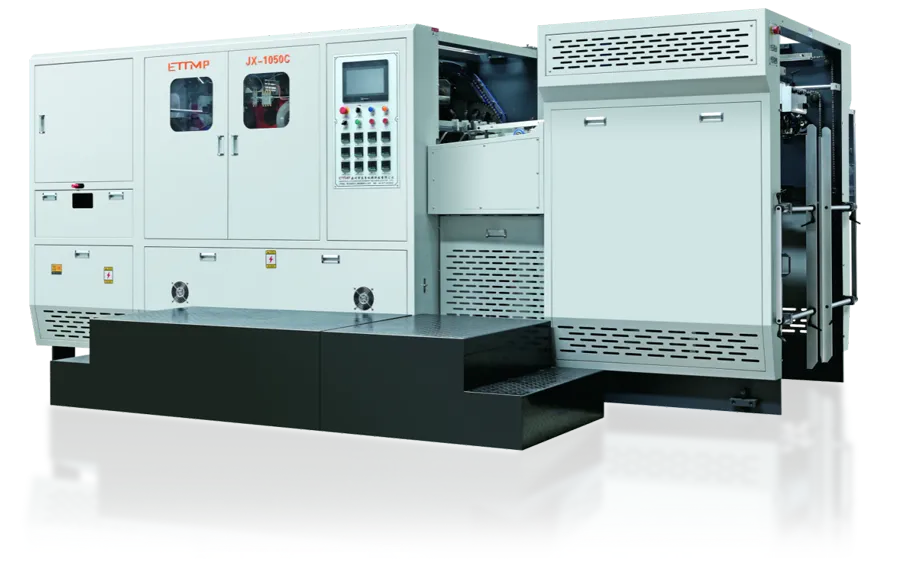
The Full Automatic Platen Foil Stamping and Die-cutting Machine from Jiexiang (Model JX-1060TZ) processes sheets up to 1060×750mm at speeds up to 7,500 sheets/hour, with stamping accuracy of ±0.1mm. Key features include: an intermittent mechanism imported from Taiwan for precise gripper movement; a ductile‑iron frame with German‑spec crankshaft for stability under high loads; a 3‑longitudinal + 2‑transverse foil feed system with Inovance servo motors and PLC; automatic pressure adjustment via touchscreen; double‑sheet detector that prevents misfeeds; non‑stop auxiliary paper delivery; and an automatic lubrication system with cooling fan for 24/7 operation. The machine is backed by a one‑year warranty, video‑based remote troubleshooting, and a professional after‑sales service team. Jiexiang offers customized options: specialized pressure rollers for thin paper, extended workbenches for extra‑large packaging, and energy‑saving modules projected to cut electricity costs by over 15% annually. Spare parts are stocked in regional warehouses with 48‑hour delivery to most markets.
Questions from the Finishing Department
Can the same machine handle both foil stamping and die‑cutting without compromising either? Yes. The JX-1060TZ is a dual‑purpose machine, not a dedicated stamper with an add‑on cutting function. The stamping and cutting sections share the same gripper system, ensuring registration accuracy across both operations. Many competing machines sacrifice die‑cutting pressure for foil stamping precision; Jiexiang’s design balances both.
What materials does it process? Cardboard, corrugated paper, greyboard, plastic sheet, and waterproof‑coated board. Flute types range from micro‑B to heavy‑duty BC flute. The auto pressure adjustment handles thickness changes without manual recalibration.
How often does the foil feed need adjustment? The vertical feed system accommodates foil rolls up to 250mm diameter. Two brush rollers remove waste foil automatically, and the collection rack pulls out for quick replacement. For typical runs, operators check tension at the start of each shift and adjust only if foil breaks occur.
Does the machine require a dedicated operator? One trained operator can run the machine while monitoring quality and performing basic adjustments. The touchscreen interface and automatic lubrication reduce constant supervision. For high‑volume 24/7 operations, some shops assign one operator to two machines running similar jobs.
Ready to Cut Your Finishing Time in Half?
If your packaging operation runs high‑end gift boxes, cosmetic cartons, pharmaceutical packaging, or food gift boxes, a dual-purpose finishing line eliminates the bottleneck of separate passes. Fewer handling steps mean lower labor costs. Perfect registration between stamping and cutting means less scrap — often less than 2% after a short optimization period. One machine means more floor space for other equipment. And with changeover times under 15 minutes, you can run shorter jobs profitably.
[Request a quote from Jiexiang for the Full Automatic Platen Foil Stamping and Die-cutting Machine] — Share your typical sheet size, board weight (gsm), monthly volume, and foil stamping requirements (solid area vs fine detail, single vs multi‑directional). Their technical team will recommend the right configuration and provide a sample test run with your materials.