 English
 Español
 عربي
عربي A run of luxury gift boxes comes off the press. The foil looks great on the left side of the sheet, but the right side is patchy and incomplete. Or the pattern repeats perfectly for 500 sheets, then suddenly shifts. Inconsistent foil stamping wastes expensive electroplated foil, delays production, and damages customer confidence. On an Automatic Foil Hot Stamping Machine, most quality problems trace to one of four root causes—uneven platen pressure, incorrect temperature, foil feed inconsistencies, or registration drift from worn mechanical components. The good news is that you can diagnose most of these issues without calling a service technician. This guide walks through each root cause in order of how often they appear, gives you simple on‑press tests to confirm each, and shows adjustments that restore quality without replacing expensive parts.
What the stamped sheet tells you
The way the foil transfers tells you as much about the cause as the fact that it failed at all.
Pattern complete on one side, incomplete or missing on the other. Foil transfers perfectly on the left edge of the sheet but is faint or absent on the right. This points to uneven platen pressure—the upper platen is not parallel to the lower platen, or the stamping forme is not flat.
Pattern sharp in the center, blurred or incomplete at the corners. The center of the design stamps cleanly, but the outer edges of the sheet show incomplete transfer. The stamping pressure is too low overall, or the temperature is too low to activate the foil adhesive at the extremities.
Pattern blurred, with foil “bleeding” beyond the design edges. Foil extends beyond the intended image boundaries, creating fuzzy edges. Temperature is too high, pressure is too high, or dwell time is too long. The foil adhesive has become too fluid and spread beyond the stamping forme.
Foil peels off easily or flakes after stamping. The foil transfers but does not adhere firmly. This is almost always a temperature issue—the die temperature is too low to activate the release layer and adhesive, or the dwell time is insufficient.
Intermittent pattern shift—perfect for a while, then drifts. The stamped position suddenly shifts on the sheet, then may return. This points to registration drift from loose chains, worn drive components, or sensor misalignment.
Pressure imbalance: the most common culprit
Symptoms of uneven pressure. Foil transfers completely on one side of the sheet but is faint or missing on the other. The stamped image shows a graduated effect, with strong transfer at one edge and weak transfer at the opposite edge. Inspect the stamped sheet against a light source—uneven pressure reveals itself as a gradient in transfer quality.
Why flat‑bed stamping is especially sensitive. On a flat‑bed press, the entire platen contacts the sheet simultaneously. Even a tiny tilt in the upper platen means some areas receive full pressure while others receive almost none. Over time, vibration, uneven wear on the guide rails, or small shifts in the toggle linkages can unlevel the platen.
How to check. Place four strips of pressure‑indicating film (or carbon paper) at each corner of the lower platen. Run a single stamping cycle at normal pressure. Examine the marks. If all four show equal density, the platen is level. If one corner shows a lighter mark, the platen is tilted away from that corner. Measure the gap between the platens at each corner with a feeler gauge. Any variation exceeding 0.05 mm needs correction.
Adjustment procedure. On most flat‑bed hot foil stamping machines, leveling adjustments are made at the toggle linkages or tie‑rod connections. Locate the adjusting nuts or eccentric shafts at the four corners of the platen drive mechanism. Slightly loosen the lock nuts. Turn the adjusting nut clockwise to increase pressure at that corner or counterclockwise to decrease it. After each adjustment, run another test sheet with pressure‑indicating film. Repeat until all four corners show equal pressure density. Retighten all lock nuts. On the Jiexiang JX‑1040C and JX‑1060T series, the automatic pressure adjustment control device simplifies this process, allowing the operator to achieve even pressure distribution without manual shimming.
Temperature drift: how foil sticking and peeling guide your diagnosis
Temperature is the second most common variable affecting stamping quality, but it rarely fails abruptly. Temperature issues usually appear gradually—the run starts perfectly, then quality degrades after 500 sheets.
Symptoms of incorrect temperature. Too cold: Foil transfers incompletely, the stamped image is faint or has a mottled appearance, and the foil peels off easily. Too hot: Foil “bleeds” beyond the design edges, creating blurred or fuzzy images. The foil sticks to the die after stamping, causing tearing or incomplete transfer on subsequent sheets.
What changes temperature during a run. The heater bands cycle on and off to maintain setpoint, but at high stamping speeds (e.g., 4,800 sheets/hour on the JX‑1040C), the die loses heat faster between cycles. The actual die temperature may drop 5–10°C below the controller reading at full production speed. The Jiexiang machine achieves ±1°C precision temperature control, but even then, the operator should verify temperature with a contact pyrometer on the die surface during actual production.
How to diagnose and adjust. Verify the setpoint temperature matches the recommended range for your foil type. Most electroplated foils transfer best between 110°C and 140°C, depending on the substrate. If the image is faint, increase temperature in 5°C increments. If foil bleeds or sticks, decrease temperature in 5°C increments. Allow 2–3 minutes for temperature to stabilize between adjustments. Use a contact pyrometer directly on the die surface—controller readings can be 5–10°C off due to sensor placement and heat losses. The Jiexiang system’s ±1°C precision, combined with intelligent foil management, helps maintain stable temperature across long production runs.
Foil feed issues: when the transfer medium itself is the problem
Foil feed problems often masquerade as pressure or temperature issues. The machine stamps correctly, but the foil is not being presented to the substrate properly.
Symptoms. Incomplete transfer in the center of a large solid area, but the edges transfer correctly. Foil tears or jams during stamping. The stamped image shows ghosting—a faint, offset version of the design next to the primary image. Vertical streaks appear at regular intervals on the stamped sheet.
Causes and fixes for common foil feed issues. Foil tension too loose: The foil wrinkles between the unwind and the stamping station, causing uneven contact. Adjust the brake tension on the unwind shaft. For large solid areas, the vertical foil feed system may be working harder than usual. Increase the foil feed advance to ensure fresh foil reaches the die with each cycle. Foil tension too tight: The foil tears under high tension, especially at the edges. Reduce the brake tension and verify that the foil take‑up shaft is not pulling too aggressively. Misaligned foil track: The foil is not centered over the stamping die, causing incomplete transfer on one side. Adjust the tracking guides or lateral foil feed mechanism. The Jiexiang JX-1040C uses three vertical and two horizontal Inovance servo motors for precise multi‑directional foil feeding, which reduces foil waste and minimizes misalignment. Excess foil dust or debris: Accumulated foil residue on guide rollers creates drag that causes intermittent foil slip. Clean all guide rollers and the foil path with a lint‑free cloth and isopropyl alcohol. For demanding applications requiring holographic or metallic effects, the system’s electroplated aluminum achieves 0.1μm coating precision with only 9% consumable loss, ensuring consistent foil release across thousands of impressions.
Registration drift: mechanical wear you can spot before it fails
Registration drift is the most dangerous failure mode because it often appears intermittently—the machine stamps perfectly for hundreds of sheets, then one sheet shifts, then it returns to perfect registration. The root cause is almost always mechanical wear in the drive train or gripper system.
Symptoms of registration drift. The stamped position shifts relative to the printed image on the sheet, the error appears suddenly and may disappear just as quickly, the problem worsens at higher stamping speeds, and the pattern repeats every full press cycle (indicating a worn cam or gear). The intermittent nature of registration drift makes it especially frustrating. The root cause is mechanical wear that only becomes apparent at certain points in the press cycle.
How to diagnose mechanical wear. Worn chains and sprockets: With the press stopped, grasp the main drive chain and attempt to lift it off the sprocket. Visible gaps indicate chain elongation. Replace stretched chains before they skip teeth. Loose gripper bar: At the sheet infeed, grasp the gripper bar and rock it back and forth. Any play indicates worn gripper bearings or loose mounting bolts. Misaligned side guide: During a run, observe the sheet as it enters the front guides. If the sheet shifts laterally, the side guide is not holding the sheet consistently. Cam follower wear: With the press at top dead center, attempt to rotate the cam follower by hand. If it spins freely, the bearing is worn. On the Jiexiang JX-1040C, the intermittent mechanism imported from Taiwan ensures precise machine movement, while the centerline positioning system enables quick sheet changeovers without losing registration.
Quick diagnostic reference
| Symptom | Most Likely Cause | First Check | Corrective Action |
|---|---|---|---|
| Pattern sharp on left, faint on right | Uneven platen pressure | Pressure‑indicating film at four corners | Adjust toggle linkage or use automatic pressure control |
| Faint or incomplete pattern overall | Temperature too low | Measure die surface temperature with pyrometer | Increase temperature in 5°C increments |
| Blurred edges, foil bleeding | Temperature or pressure too high | Check controller settings; verify pyrometer reading | Decrease temperature or reduce pressure |
| Foil peeling after stamping | Temperature too low or dwell time insufficient | Test stamp with longer dwell; verify temperature | Raise temperature; adjust timing cam |
| Random pattern shift | Registration drift | Inspect chain tension; check gripper bar play | Replace worn chains; adjust grippers |
| Vertical streaks at regular intervals | Foil tension uneven | Check foil path for debris; verify tension brake | Clean rollers; adjust brake tension |
| Foil tearing during stamping | Foil tension too high | Observe foil movement during cycle | Reduce brake tension; adjust take‑up speed |
Questions from production managers
Q: How often should I check platen parallelism?
A: On a high‑volume Automatic Foil Hot Stamping Machine running 2‑3 shifts daily, check parallelism once per week. After any maintenance that involves the toggle linkages or drive train, always re‑verify platen leveling before production.
Q: Why does stamping quality degrade after the machine has been running for an hour?
A: The die temperature may be drifting downward despite the controller reading the setpoint. Heat is lost from the die surface during high‑speed stamping, especially on large‑area designs. Verify the actual die surface temperature with a pyrometer during production. The Jiexiang machine’s ±1°C precision temperature control helps minimize drift, but periodic verification is still recommended.
Q: Can I use the same foil tension settings for all substrates?
A: No. Thin paper (under 150 gsm) requires lower foil tension to prevent tearing. Thick board (over 400 gsm) requires higher tension to ensure the foil feeds cleanly without wrinkling. Always optimize tension for each substrate‑foil combination.
Q: What is the first thing to check when foil does not transfer at all?
A: Verify the foil is loaded with the coated side facing the substrate. Electroplated aluminum foil is directional. If loaded backward, the release layer faces away from the substrate and the foil will not transfer regardless of temperature or pressure.
Q: What is the expected service life of key hot stamping machine components?
A: With proper maintenance, heater bands typically last 2,000–3,000 operating hours. Drive chains should be replaced every 5,000 hours or when elongation exceeds 2% over original length. The QT600-7 ductile iron frame is designed for permanent deformation resistance, providing a service life exceeding 15 years. The crankshaft, machined from German nickel‑chromium‑molybdenum steel, maintains precision across millions of cycles. Document component replacement dates in a maintenance log to track wear patterns over time.
The machine built for consistent hot foil stamping
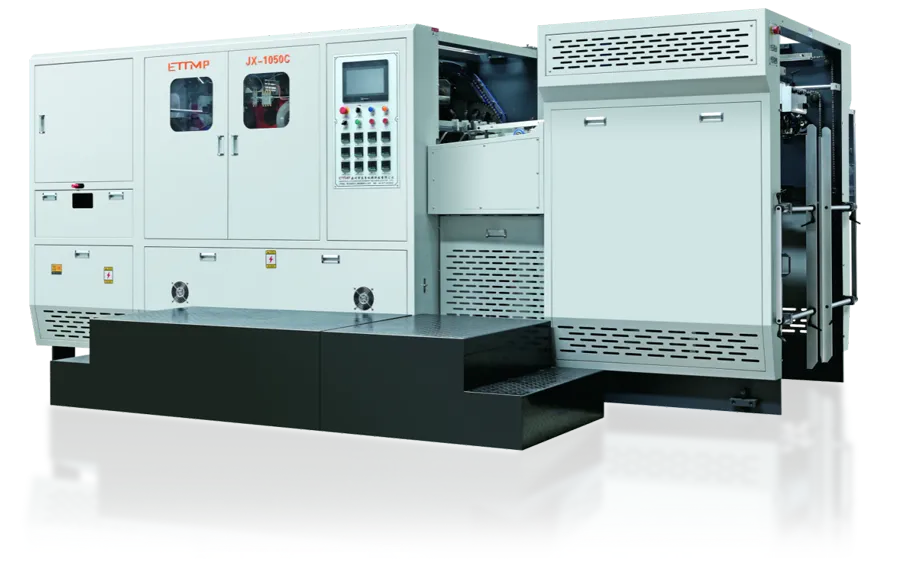
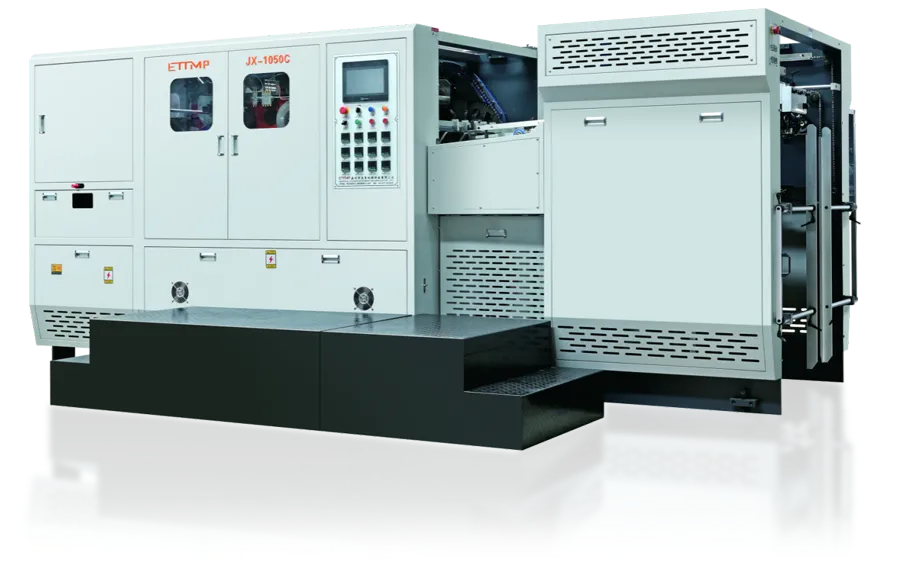
When inconsistent stamping costs you time and materials, the engineering behind the equipment determines how quickly you can restore quality and how long the press maintains adjustment. Jiexiang Machinery manufactures the Fully Automatic Flat-bed Hot Foil Stamping Machine (Model JX‑1040C) with features that directly address the four root causes of stamping defects.
The JX‑1040C achieves a maximum working speed of 4,800 sheets per hour with a foil stamping accuracy of ≤±0.15mm. All castings are made of QT600-7 ductile iron for high strength and permanent deformation resistance. The intermittent mechanism imported from Taiwan ensures precise machine movement, while the crankshaft machined from German nickel‑chromium‑molybdenum alloy steel provides high precision under continuous high‑load stamping. The machine uses components from Mueller, Omron, Schneider, and Panasonic, with pneumatic components from Taiwan Airtac.
Key features include a Jiexiang automatic pressure adjustment control device for fast and accurate die‑cutting and stamping pressure adjustment, a centerline positioning system for quick sheet changeovers, a double sheet detector, non‑stop paper delivery, an automatic oiling system with cooling fan, and a Chinese/English touchscreen interface. The main PLC uses Inovance Technology (stock code 300124) to ensure smooth machine operation. The three‑vertical and two‑horizontal foil feed mechanisms all utilize Inovance servo motors and an Inovance PLC control system, enabling simultaneous multi‑directional stamping that reduces foil usage and saves foil changing time.
For converters who need both foil stamping and die‑cutting, the JX‑1060T and JX‑1060TZ models offer dual‑purpose capability at 7,500 sheets/hour and ±0.1mm accuracy. All Jiexiang machines are backed by a one‑year warranty, video‑based remote troubleshooting, and professional after‑sales service.
→ Request a quote from Jiexiang Machinery for the Fully Automatic Flat-bed Hot Foil Stamping Machine (JX‑1040C) — Share your typical sheet size, substrate type (paper, board, plastic, etc.), foil type, and monthly volume. Their technical team can recommend the right machine configuration and provide on‑site stamping optimization training.