 English
 Español
A sheet of wine box blank enters the feeder. A suction head lifts the sheet, an air blast separates it from the pile, and the sheet travels onto the feed table. The side gauge aligns it. The platen closes. The heated die presses the foil against the sheet, the foil transfers the metallic image, and the platen opens. The sheet advances to the die‑cutting station. Another platen closure cuts the blank to its final shape, strips the waste, and ejects the finished box. The entire cycle repeats 4,800 to 7,500 times every hour.
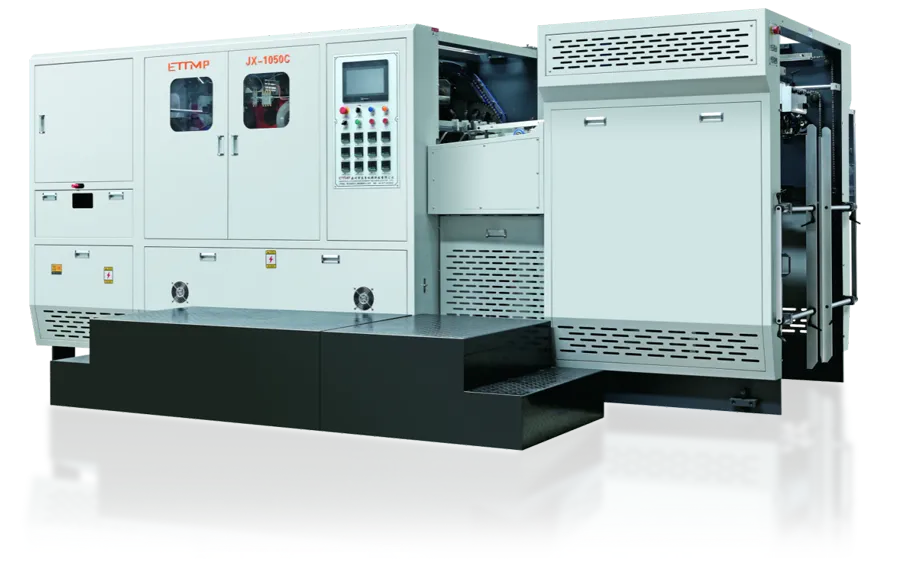
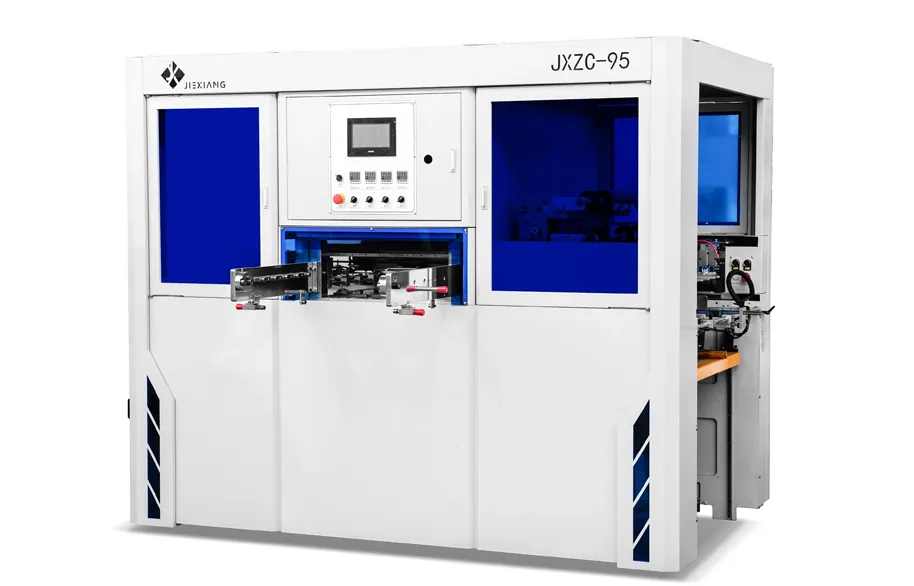
That is a automatic hot stamping and die cutting machine . The JX‑1040C and JX‑1060T/JX‑1060TZ are fully automatic flat‑bed foil stamping and die‑cutting presses. The JX‑1040C runs at 4,800 sheets per hour with ±0.15mm stamping accuracy. The JX‑1060T and JX‑1060TZ run at 7,500 sheets per hour with ±0.1mm accuracy. This article explains what "heavy‑duty" means in terms of frame construction and component sourcing, how the servo‑driven longitudinal and transverse foil feed system reduces foil waste, and why the machine performs both stamping and die‑cutting in one pass.
The Heavy‑Duty Foundation: Why the Machine Starts with a Ductile‑Iron Frame
A stamping press that cycles 7,500 times per hour cannot be built from ordinary cast iron. The frame would flex, the platen would misalign, and the registration would drift. The JX‑1060T and JX‑1060TZ use QT600‑7 ductile iron, a material with nearly twice the tensile strength of grey cast iron. The frame is a single monolithic casting, not a welded assembly. Ductile iron absorbs the shock of the platen closure without cracking and dampens vibration so the foil stays in register across the entire run.
The intermittent mechanism is imported from Taiwan. It converts the rotary motion of the main drive motor into the reciprocating motion of the platen. The mechanism is sealed inside the gear housing to keep dust and paper debris out of the precision cam paths. The crankshaft is made of German nickel‑chromium‑molybdenum steel, diamond‑lapped to a fine finish so the bearings run without play.
The machine also includes an automatic oiling system with a cooling fan on the oil pump. The oil circulates through the gear housing and the main bearings, lubricating the intermittent mechanism and the platen toggle linkage. The fan prevents the oil from overheating on long runs, maintaining viscosity and preventing gear wear. A maintenance technician checks the oil level weekly, not daily.
Servo‑Driven Foil Feed: Why Longitudinal and Transverse Axes Reduce Foil Waste
A automatic hot stamping and die cutting machine with only longitudinal foil feed pulls the foil in one direction. If the job has stamps on the left and right edges of the sheet, the press pulls a full‑sheet length of foil for each impression, leaving a broad strip of unused material between the stamps.
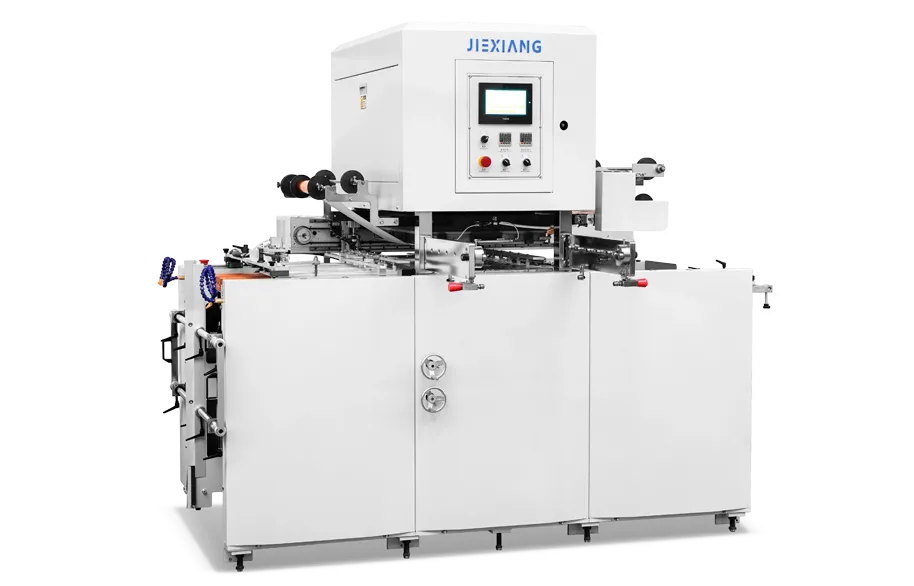
The JX‑1040C and JX‑1060T series use three vertical and two horizontal foil feed mechanisms, all driven by Inovance servo motors and controlled by an Inovance PLC. The vertical axes pull the foil across the sheet; the horizontal axes reposition the foil laterally. When the die has multiple stamping positions, the foil is pulled only the distance needed for each stamp, moving sideways between impressions without wasting an entire sheet width of foil. The longitudinal‑transverse feed pair, combined with real‑time PLC control and servo‑driven axes, reduces foil consumption by 20‑30% compared to single‑directional systems.
The foil feed mechanism is located in the front of the machine. The vertical foil collection mechanism is located behind the vertical foil feed mechanism, with two collection methods for user convenience. Two brush rollers remove waste foil, and the foil collection and placement rack can be pulled out for easy foil roll replacement. The maximum foil diameter is 250mm for the vertical shafts.
| Feature | JX‑1040C | JX‑1060T / JX‑1060TZ |
|---|---|---|
| Max working speed | 4,800 sheets/h | 7,500 sheets/h |
| Stamping accuracy | ≤±0.15mm | ≤±0.1mm |
| Foil feed axes | 3 vertical + 2 horizontal | 3 vertical + 2 horizontal |
| Frame material | QT600‑7 ductile iron | QT600‑7 ductile iron |
| Intermittent mechanism | Imported from Taiwan | Imported from Taiwan |
| Main PLC | Inovance | Inovance |
| Drive components | Mueller, Omron, Schneider, Panasonic | Mueller, Omron, Schneider, Panasonic |
| Crankshaft | German nickel‑chromium‑molybdenum | German nickel‑chromium‑molybdenum |
| Pneumatic components | Airtac (Taiwan) | Airtac (Taiwan) |
Data sourced from JX‑1040C and JX‑1060T/JX‑1060TZ product specifications.
Why the servo‑driven foil feed also saves setup time
The operator stores the foil pull length for each stamping position in the job recipe. When the job repeats, the servo motors reposition the foil shafts automatically. The operator does not need to measure the distance between stamps and adjust mechanical stops. The recipe also stores the foil tension curve. A foil that stretches under pull requires a different tension than a stiff metallic foil.
Automatic Pressure Adjustment: Why the Machine Sets the Tonnage Without a Mechanic
A automatic hot stamping and die cutting machine must apply different pressures for different jobs. A wine box logo requires higher tonnage than a greeting card border; too much pressure crushes the cardstock, too little leaves a faint impression. On a mechanical press, the operator adjusts a threaded stop or changes the toggle linkage position — a 15‑minute job that requires a mechanic.
The Jiexiang automatic pressure adjustment control device sets the tonnage through the touch screen. The operator enters the required pressure, and the servo‑driven mechanism repositions the toggle links. The pressure is adjustable in 0.01mm increments of the platen stroke. For a job that repeats monthly, the operator stores the pressure setting in the recipe. The next time the job runs, the machine resets the tonnage automatically without a mechanic touching the toggle links.
The automatic pressure adjustment is integrated with the centerline positioning system, which centers the sheet on the die. The operator sets the sheet size on the touch screen, and the system adjusts the side gauges and the front lays. A changeover that used to take 30‑40 minutes on a manual press takes under 10 minutes on the JX‑1060T.
The die‑cutting pressure is also adjustable. The machine uses a hydraulic pressure system for die‑cutting, separate from the mechanical toggle mechanism for stamping. The operator sets the cutting pressure on the touch screen; the system applies the force evenly across the entire cutting area. A ±0.1mm die‑cutting accuracy means a folding carton with a cut window around a foil brand mark will have the window centered within 0.1mm.
Two Stations in One Pass: Why Stamping and Die‑Cutting on the Same Press Eliminates Inter‑Pass Misalignment
A separate foil stamper and die‑cutter require two passes. The sheet is stamped, stacked, moved to the die‑cutter, re‑registered, and cut. The registration between the stamp and the cut can drift by 0.2‑0.3mm, enough to make a foil border appear off‑center.
The JX‑1060TZ is a dual‑purpose machine that performs both hot foil stamping and die‑cutting in one pass. The sheet registers once to the gripper edge. The foil station stamps the image, and the die‑cutting station cuts the shape. The same gripper bar holds the sheet through both stations, so the registration is fixed by the machine, not by the operator. The finished product has the foil exactly where the die‑cut window should be.
The machine also performs waste stripping. After die‑cutting, a set of pins pushes the internal cut‑outs down into a conveyor. The conveyor carries the waste to a bin at the side of the press. The operator empties the bin at the end of the shift, not during production. For a job with small internal windows (e.g., a greeting card with a 10mm circular cutout), the automatic waste stripping prevents the waste from jamming the die‑cutting station.
The double sheet detector uses an ultrasonic sensor or a mechanical feeler to detect when two sheets feed together. If a double sheet is detected, the press stops before the die closes on double thickness, which would break the cutting chase or bend the heating platen. The operator clears the double sheet from the feed table and restarts.
Components Sourcing: Why the Machine Uses Mueller, Omron, Schneider, and Panasonic
A automatic hot stamping and die cutting machine that runs 24 hours a day must have reliable components. Jiexiang sources key components from established industrial suppliers.
-
Mueller supplies the suction cups and air blast components for the pneumatic feeder.
-
Omron supplies the photoelectric side gauge sensors and the double sheet detector.
-
Schneider supplies the temperature controllers for the heating platen.
-
Panasonic supplies additional sensors and the operator interface components.
-
Airtac (Taiwan) supplies the pneumatic cylinders and valves for the foil feed and the waste stripping system.
-
Inovance supplies the main PLC and the servo drives for the foil feed axes.
The touch screen interface is available in Chinese and English. The operator selects the language on startup. The screen displays real‑time data: current speed, sheet count, temperature of each heating zone, and fault codes. When a foil roll is near empty, the screen alerts the operator to prepare a replacement.
How the JX‑1040C and JX‑1060T Fit into a Packaging Finishing Line
Jiexiang Machine has manufactured flat‑bed foil stamping presses for over two decades. The JX‑1040C and JX‑1060T/JX‑1060TZ models are fully automatic, heavy‑duty presses that perform hot foil stamping and die‑cutting in one pass. They are built on QT600‑7 ductile‑iron frames with German crankshafts and Taiwan intermittent mechanisms. The foil feed uses three vertical and two horizontal servo‑driven axes controlled by an Inovance PLC. The maximum working speed is 4,800 sheets/h for the JX‑1040C and 7,500 sheets/h for the JX‑1060T/JX‑1060TZ, with stamping accuracy of ≤±0.15mm and ≤±0.1mm respectively. Automatic pressure adjustment is standard. The machine carries a 1‑year warranty and CE certification, with after‑sales service including video exchange and a professional support team.
A automatic hot stamping and die cutting machine that stamps and die‑cuts in one pass, holds ±0.1mm registration at 7,500 sheets per hour, and reduces foil waste with servo‑driven longitudinal and transverse feed reduces setup time, lowers material cost, and keeps a finishing line running through the shift. For a packaging converter running wine boxes, greeting cards, or cosmetic cartons, the JX‑1040C and JX‑1060T/JX‑1060TZ deliver the speed, accuracy, and integrated workflow that separate a profitable operation from a scrap‑prone one.
【Request a quote from Jiexiang Machine】
Contact Jiexiang with your maximum sheet size (e.g., 1060×740mm for the JX‑1060T), stamping area, and required number of foil axes to receive a machine configuration recommendation and a sample‑run video.