 English
 Español
A greeting card converter in Shenzhen replaced their old clamshell stamper with a sheet‑fed flat‑bed foiler. At 4,800 sheets per hour, the old machine vibrated enough to shift the foil by 0.3 mm, turning the gold logo on a wedding invitation into a blurred edge. The new automatic foil hot stamping machine sits on a QT600-7 ductile iron frame. The material dampens vibration so the foil stays in register across the entire run, even at full speed.
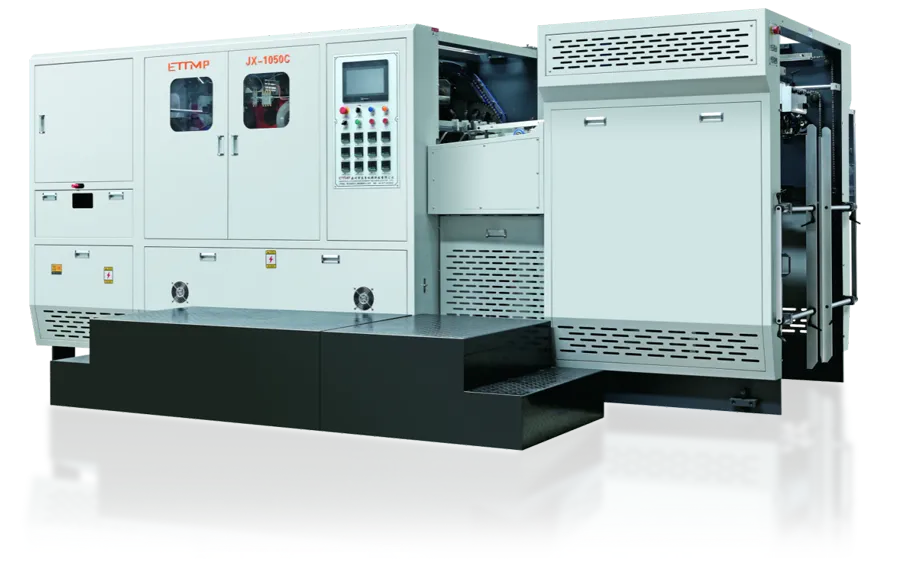
The Full Automatic Sheet-fed Heavy-duty Foil Stamping Machine from Jiexiang is a flat‑bed press that feeds individual sheets, stamps foil with heat and pressure, and delivers finished stacks. It runs at 4,800 stamps per hour, registers within ±0.15 mm, and stamps sheets up to 1040 mm × 740 mm. The frame is cast in one piece from ductile iron, and the intermittent motion mechanism is imported from Taiwan.
An automatic foil hot stamping machine that runs sheet after sheet must handle the shock of the platen closing and opening thousands of times per shift. This article explains why a ductile‑iron frame is the foundation of high‑speed registration, how longitudinal and transverse foil feed reduce foil waste, and where the automatic pressure adjustment keeps deep‑embossed logos consistent from first sheet to last.
Ductile‑iron frame: why the foundation determines whether 0.15 mm register holds for 10,000 sheets
A flat‑bed press works like a stamping press. The platen rises, the gripper bar places a sheet, the platen closes, heats the foil, presses it into the substrate, and opens. If the frame flexes during the closing stroke, the foil‑transfer area shifts.
The Jiexiang press uses QT600-7 ductile iron, a material seven times stronger than grey cast iron in impact resistance. The fully automatic sheet-fed heavy-duty foil stamping machine is built with a monolithic casting. The intermittent‑motion mechanism, imported from Taiwan, synchronizes the gripper travel with the platen stroke, so the sheet arrives exactly when the heated plate is ready to press, cycle after cycle.
Why the intermittent mechanism matters
A continuous‑motion feeder never stops moving the sheet. A flat‑bed stamper needs the sheet to pause while the platen closes. The intermittent mechanism does exactly this: advances the sheet at high speed, stops it precisely under the die, holds it still for the stamping cycle, then accelerates it out. The imported mechanism from Taiwan maintains this stop‑start motion with repeatable precision.
Longitudinal and transverse foil feed: why two directional axes cut foil waste by letting you stamp multiple positions from one roll
Conventional foil stamping pulls the foil only in the machine direction. If the job has stamps on the left and right edges of the sheet, the press pulls a full‑sheet length of foil for each impression, leaving a broad strip of unused material between the stamps.
The Jiexiang press uses longitudinal and transverse foil feed, driven by independent Inovance servo motors. The longitudinal axis pulls the foil across the sheet; the transverse axis repositions the foil laterally. When the die has multiple stamping positions, the foil is pulled only the distance needed for each stamp, moving sideways between impressions without wasting an entire sheet width of foil. The three vertical shafts and two horizontal shafts all receive commands from the central PLC, so a multi‑stamp job that would waste 30% of foil on a single‑directional press consumes only the required area for each stamp.
The control system calculates the shortest path to the next stamp position before each cycle. At 4,800 sheets per hour, the system has 0.75 seconds per cycle to compute and move the foil axes. The Inovance servo drives respond within milliseconds, meaning the foil is already positioned before the platen begins its descent. The operator saves the foil feed profile for each job. The next time that wine label runs, the coordinates reload, and the press does not waste the first 20 sheets testing foil pull distances.
Automatic pressure adjustment and 0‑200℃ temperature: why a wine box logo needs a different setting than a greeting card border
A deep‑embossed wine box logo requires stamping pressure of around 0.5 MPa. A fine greeting card border requires less than half that – too much pressure will crush the cardstock, and the embossed texture will crack at the fold.
The Jiexiang press includes an automatic pressure adjustment control device that lets the operator set stamping pressure through the touch screen. The pressure setting is stored in the job recipe. When the operator recalls the wine box job, the press sets the tonnage automatically; when the greeting card order runs, it reduces pressure without a mechanic touching the toggle links.
The stamping temperature range is 0‑200℃, adjustable in 1° increments. Wine box foil requires around 140‑160°C; high‑metallic holographic foils need 120‑130°C. The controller uses PID loops to keep each zone within ±2°C of the setpoint, monitored individually. The temperature‑controlled platen is divided into multiple heating zones so a full‑bleed design transfers evenly across the entire sheet.
The platen uses German‑made nickel‑chromium‑molybdenum steel for the crankshaft, which handles the cyclic stamping load without fatigue cracking. The steel is diamond‑lapped to a fine finish so the bearings run without play, maintaining 0.15 mm registration even after millions of operations.
| Specification | JX-1040C Model |
|---|---|
| Max working speed (sheets/h) | 4,800 |
| Foil stamping accuracy (mm) | ≤±0.15 |
| Max sheet size (mm) | 1040 × 740 |
| Stamping temperature range | 0‑200°C |
| Frame material | QT600-7 ductile iron |
| Intermittent mechanism | Imported from Taiwan |
| Main PLC | Inovance |
| Foil feed axes | 3 vertical + 2 horizontal (servo) |
Pneumatic paper feed and double‑sheet detection: why a jam that would stop a manual stamper is cleared without a service call
The sheet‑to‑sheet feeder uses pneumatic suction heads to lift the top sheet from the pile and pull it onto the feed table. The Panasonic photoelectric side gauge ensures the sheet is square before it enters the stamping station. If a sheet is skewed, the side gauge signals the feeder to reject it and try again, rather than sending a misaligned sheet into the stamping die.
The double‑sheet detector uses ultrasonic through‑beam sensors. If two sheets feed together, the detector interrupts the cycle. The press stops before the die closes on double thickness, which would break the cutting chase or bend the heating platen. The operator clears the double sheet from the feed table and restarts. A backup in a manual stamper would require the operator to reach into the moving part of the press; the Jiexiang system stops automatically, reducing the chance of an injury during clearing.
The paper delivery table has an automatic auxiliary paper delivery function. As the finished stack builds, a secondary platform swings into position so the operator can remove the finished pile without stopping the press. On a 10,000‑sheet run of wine boxes, the press runs uninterrupted while the operator pulls stacks at the delivery end, saving 3‑5 minutes per stop.
Oil‑bath lubrication and maintenance schedule: why 5,000 hours of operation do not require a rebuild on the main spur gear
A flat‑bed stamper has a main spur gear that drives the intermittent motion and the platen toggle linkage. If the gear wears, the timing between the feeder and the stamping die drifts, and the foil lands off‑register.
The automatic oiling system lubricates the gear and all bearings with an automatic cooling fan on the oil pump to prevent overheating on long runs. The oil flows through distribution lines to the main gear, the toggle links, and the foil feed spindles. The controller monitors oil level and alerts the operator when a refill is needed, but the system is sized so a 24‑hour shift consumes minimal oil. The gearbox is rated for 5,000 hours between major overhauls. In a single‑shift shop, that is two to three years of operation before the gear needs to be inspected for wear.
The intermittent‑motion mechanism is sealed inside the gear housing to keep dust and paper debris out of the precision cam paths.
Why the automatic oil pump uses a cooling fan
The stamping press has a heavy gear case that can reach 70‑80°C after a long run. The oil‑pump motor runs continuously, and the recirculated oil absorbs heat from the gears. The cooling fan extends the oil life and prevents the viscosity from dropping. Lower viscosity oil would thin out, fail to form a film between the gear teeth, and accelerate wear, causing the machine's timing to drift.
How the Jiexiang full automatic sheet-fed heavy-duty foil stamping machine fits into a packaging converter’s post‑press line
Jiexiang Machine (Wuxi Jiexiang Machinery Co., Ltd.) has manufactured flat‑bed foil stamping equipment and die‑cutting presses. The JX‑1040C full automatic sheet-fed heavy-duty foil stamping machine is designed for packaging converters who run wine boxes, greeting cards, cosmetic cartons, and cigarette packs. The press uses components from Möller, Omron, Schneider, and Panasonic; pneumatic parts from Airtac; a main PLC from Inovance; and a crankshaft made of German nickel‑chromium‑molybdenum steel.
An automatic foil hot stamping machine that holds ±0.15mm register at 4,800 sheets/hour, feeds foil in two directions to cut waste, and adjusts stamping pressure automatically for each job keeps a post‑press line running through the shift. For a converter who runs a mix of heavy embossing and fine foil detail, the Jiexiang JX-1040C delivers the ductile‑iron frame, servo‑driven foil axes, and automatic pressure control that make a dual‑purpose press a replacement for two separate machines.
【Request a quote from Jiexiang Machine】
Contact Jiexiang with your maximum sheet size, target stamping speed, and typical foil type (metallic, hologram, or soft touch) for a JX‑1040C specification and custom pressure‑setting demonstration.