 English
 Español
A procurement manager at a mid-size folding carton plant runs the math and realizes that switching to a lower-priced die cutting machine could save nearly 40% on the capital request. On paper, the output specs look almost identical. Stroke speed, cutting force, sheet size—the columns match line by line. The decision feels rational, even responsible.Eighteen months later, the same manager sits in a quarterly review explaining why the finishing department’s cost-per-thousand sheets has actually gone up by 12%. The cheap machine hasn’t died. It just quietly, relentlessly, consumes margin in places no spreadsheet ever captures.
That’s the nature of hidden costs in flatbed die cutting. They don’t announce themselves as a machine failure. They show up as extra shifts, as client complaints about foil consistency, as inventory buffer you never used to need. If you’re evaluating die cutting workflows right now—or nursing a budget that never seems to stretch far enough despite recent equipment purchases—these are the five holes your money may be leaking through.
1. The “Make-Ready Mirage”
Entry-level die cutters often boast quick changeover times in the brochure. What they rarely disclose is how those times were measured: with a single operator who has run the same job 50 times, on clean tooling, under no pressure to hold registration tighter than ±0.5 mm.
In reality, a short-run packaging converter flipping between five to eight jobs per shift encounters a very different picture. Crease matrix adjustments drift. Chases need re-shimming because the chase plate wasn’t precision-ground to begin with. Make-ready that should take fifteen minutes stretches into forty-five, and nobody logs the extra thirty minutes anywhere except in overtime pay.
.webp)
According to a 2022 TAPPI benchmarking study on folding carton productivity, unscheduled downtime linked to make-ready variability is the single largest source of lost capacity in independent converters operating below the 5,000-sheet-per-job threshold. On a cheap machine, you aren’t paying for the downtime—you’re paying for the cost of the press that’s waiting on it.
One experienced plant engineer put it bluntly: “We tracked our non-productive hours for a quarter. The cheap machine wasn’t cheaper. It was just a financing arrangement on hidden overtime.”
What makes this particularly insidious is that it almost never gets attributed to the asset itself. Accounting sees “labour variance”, not “excess make-ready due to poor chase plate engineering”.
2. Tooling Wear: The Consumable You Forgot to Budget
Every die cutting station eats tooling. Steel rule dies, stripping pins, make-ready tape, chase plates, cutting plates—all of these are consumables. The question is at what rate.
Professional-grade die cutters distribute pressure across well-machined platens with parallelism tolerances often specified in microns. Cheap machines run looser. The platens aren’t as flat out of the box, and they don’t stay flat. Over time, uneven pressure distribution concentrates cutting force on a small portion of the die, accelerating rule wear and increasing the frequency of re-dies. A typical converter might go from re-ruling every 150,000 impressions to every 80,000—without a corresponding entry in the “machine cost” column.
The maths is sneaky. If a die set costs 800andyoudoubleitsreplacementfrequencyacross20activediesinrotation,that’snot800andyoudoubleitsreplacementfrequencyacross20activediesinrotation,that’snot800 of extra cost. It’s $16,000 per cycle you hadn’t forecast, plus the hidden cost of the machine standing idle while the die goes back to the toolmaker.
Combined with that is the stripping pin story. On machines with less rigid frames or poorer control over stripping board parallelism, pin breakage becomes chronic. Operators compensate by adding pins, which adds make-ready time, which loops you back to problem one.
3. When Registration Drift Steals Your Margins
Registration accuracy is often reduced to a single number in the spec sheet: ±0.15 mm, ±0.2 mm. What the spec sheet doesn’t describe is the difference between holding that tolerance on a hot summer afternoon when the frame has thermally expanded versus the tenth job of the day when the operator is tired and the feeder has started double-sheeting because the gripper bar bushings have worn.
Fold-over box reveals, window alignment, and foil-to-print registration are where cheap machines unravel. The initial sheets run fine. Three hours in, a fractional drift appears. The operator tweaks. It holds. Two hours later, it’s drifted again. No single sheet is bad enough to reject, but the cumulative aesthetic mismatch eventually triggers a client phone call—and negotiated compensation that erases the net margin on the order.
A large packaging group I spoke to conducted a blind comparison between three machines on the same work—cigarette flip-top blanks with registered foil blocking. Their metric wasn’t registration itself but “customer-initiated quality claims per million delivered”. The bottom-tier press generated 4.7 times the claim rate of the top-tier system. The difference in machine financing cost between those two tiers was recovered in three months of avoided commercial penalties.
This is why some finishing lines are now looking beyond stroke speed and cutting force, toward thermal stability of the frame, dynamic registration adjustment, and sheet handling that doesn’t inch out of alignment as the shift wears on. For converters running high-graphic packaging where brand owners enforce a visual standard, these aren’t luxury features; they’re insurance against a client review that ends with “we need to talk about rates”.
4. The Unspoken Cost of Missing “Extras”
A cheap die cutter cuts. Maybe it also creases. But does it emboss inline, strip cleanly, and handle a hot foil station without requiring a standalone machine and a second pass?
Here’s where the definition of “standard configuration” splits the market. Many converters only discover after installation that the foil stamping capability on their budget system is a compromise. The foil advance might be mechanical without independent dwell time control. The heating plate might show a 15°C gradient across its width, causing inconsistent foil transfer on solid areas. Changing foil rolls between jobs takes longer than it should, and the dwell settings required for fine-line foil on uncoated board simply aren’t reachable.
The consequence isn’t that the machine can’t do foil. It’s that it can only do foil profitably on a narrow range of work. Complex jobs migrate back to the more expensive press, or get farmed out. The cheap machine ends up permanently assigned to the commodity work it should be doing, while the “real” press runs at capacity. The capacity bottleneck doesn’t get solved; it just gets re-wrapped in a different set of invoices.
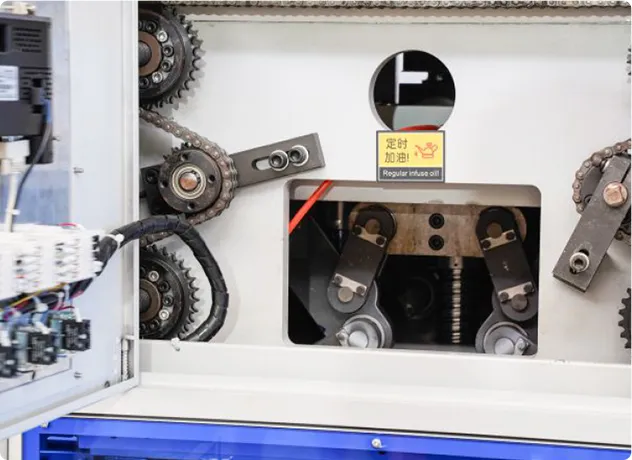
When specifiers talk about finishing lines that integrate die cutting with hot foil, embossing, and stripping in a true single-pass architecture, they aren’t describing a bells-and-whistles option. They’re describing a different category of machine economics: one where job changeover is a single event, not a sequence of events spread across two or three separate machines, each with its own make-ready, its own operator, and its own probability of delay.
5. Support That Costs More Than the Discount
An under-discussed attribute of budget finishing equipment is the shape of its support model. Spare parts responsiveness, technical phone support availability, and the depth of process knowledge you can reach are enormously variable—and they get more variable the further a machine’s home market is from where it’s installed.
One converter in Southeast Asia shared a timeline I now use as a cautionary tale: a main drive bearing failed at hour 2,200 of a cheap machine’s life. The replacement part took 19 days to arrive from the manufacturer, at a cost exceeding 8% of the machine’s entire purchase price. During those 19 days, high-margin work sat queued behind a broken asset, and two operators were temporarily reassigned to other lines, themselves causing disruptions.
Contrast that with the expectation most converters have when they invest in finishing equipment designed for 15 to 20 years of multi-shift operation: a support ecosystem that includes remote diagnostics, regionally stocked consumables, and application engineers who can consult on die and foil combinations, not just part numbers. The difference shows up not in the purchase order, but in the production report from the 19 days that never happened.
This is the point where buyers often ask, “What level of support should I actually expect at what price point?” It’s the right question—one that moves the conversation away from machine specs and toward the total cost assurance of keeping that machine running at warranted speeds in a real plant with real deadlines.
What a Total-Cost Lens Reveals
When you stack the five hidden costs—extended make-ready, accelerated tooling cycles, registration-related quality claims, constrained single-pass capability, and underinvested support—something interesting happens to the price difference. For many converters running more than a few shifts per week, the “cheap” machine fully passes the more expensive one on total cost of ownership within 18 to 36 months. After that, it costs more every day it runs.
This isn’t an argument against evaluating price. It’s an argument for evaluating price over the correct timeframe and with the correct line items. A machine’s capital cost is the only number that’s guaranteed on day one. Everything else is derived from the engineering decisions made long before you signed the order.
If your work mix includes high-graphic packaging, short runs, frequent foil requirements, or customers who enforce quality clauses, the right finishing platform isn’t necessarily the one that costs the least to acquire. It’s the one whose hidden costs have already been engineered out—through platen rigidity, thermal compensation, integrated foil and stripping design, and a support infrastructure that treats your 19 days of downtime as unacceptable.
For converters looking deeper into how single-pass systems can remove some of these hidden cost traps from the equation, it can be worth exploring JIEXIANG’s integrated approach to combining die cutting, stripping, and foil transfer in one platform. The design priorities around rigidity, thermal uniformity, and rapid changeover often speak louder than the technical specs alone.
Realistically, no machine is immune to every hidden cost. The question is which ones have been designed out of the product architecture before it reaches your shop floor. The best time to answer that question isn’t during a quarterly review of unexplained margin erosion. It’s when the procurement spreadsheet is still open—and you still control what goes into the columns.
Disclaimer: Productivity comparisons cited in this article are based on general industry observations, published TAPPI references, and discussions with finishing professionals. Individual results depend on job mix, operator expertise, tooling quality, and maintenance practices. This article does not constitute an engineering specification or performance guarantee for any specific equipment model.