 English
 Español
 عربي
عربي If you're searching for a Hot Stamping Machine, you probably don't care about cycle counts yet. What you really want to know is: “Why does my foil keep tearing on curved bottle caps?” or “How do I stop ghosting on dark cardboard?” The short answer—most machines fail because the heating zone distribution doesn’t match your substrate shape. Flat platen presses work for notebooks. For cylindrical objects or deep recessed areas, you need a roller hot stamper or a conveyorized system with independent temperature zones. Skip this, and no amount of pressure adjustment will save your rejection rate.
Tip 1: Ignore Tonnage – Measure Your Contact Area First
Here’s a mistake I see constantly. A buyer specs a 3-ton foil stamping press because a competitor uses one. Then they try to stamp a 10mm wide logo on a soft PVC tag. The result? Crushed edges and foil bleeding outside the lines. Why? Tonnage matters less than pressure per square inch. A 1-ton press with a small silicon rubber die often outperforms a 5-ton machine with a hard metal die on uneven surfaces.
Rule of thumb from actual shop floor data (Source: Foil & Specialty Effects Association, 2022):
-
Flat, rigid substrates (paperboard, rigid plastic): 50-100 PSI. Use hard brass or magnesium dies.
-
Soft or textured substrates (leather, embossed paper, fabric): 30-60 PSI. Switch to silicone-backed dies.
-
3D or stepped surfaces (bottle caps, pen barrels): Rolling pressure only. Platen presses will fail.
Before you call any supplier, press your fingernail into your product. If it leaves a dent, you need low-pressure, high-conformity stamping.
Tip 2: The “Heat Uniformity” Lie Most Suppliers Tell
Every brochure says “uniform heating.” Ask for the thermal imaging report. I’ve tested $8,000 machines with a 35°C difference between the center and edge of the heating plate. That means your logo stamps perfectly in the middle but fades at the ends. For large-area stamping (wider than 150mm), demand cartridge heaters arranged in a zigzag pattern, not single-rod heaters. Single-rod creates cold spots at the corners.
Also, warm-up time tells you more than max temperature. A quality heat transfer equipment should reach 150°C in under 8 minutes. If it takes 15 minutes, the insulation around the heating block is poor—and you’ll lose temperature every time the press opens. That’s death for high-frequency stamping cycles.
Tip 3: Foil Feeding Direction – The 90% Overlooked Detail
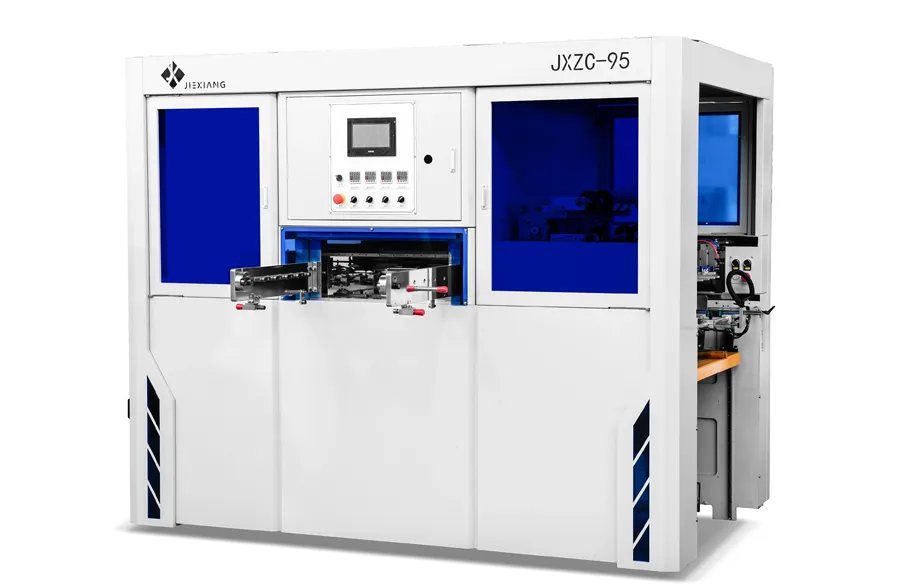
This one is personal. I watched a packaging supervisor throw a wrench across the room because his new automatic foil stamper kept jamming. The problem? The foil pull mechanism was a simple rubber roller. For thin metallic foils (12-micron), rubber slips. For thick pigment foils (30-micron), rubber crushes the edges.
What actually works:
-
Thin foils (12-18µ): Use a servo-driven nip roller with adjustable tension. Rubber is fine if the surface is textured.
-
Thick foils (25-35µ): Need a toothed drive wheel or pin feed system (like old dot matrix printers). Rubber will deform the foil edges and cause zigzag feeding.
And always ask: “Does the foil unwind from the top or bottom?” Top-feed is standard, but for static-sensitive foils (common on holographic stamping), bottom-feed with an ionizing bar reduces static cling and jams by about 60%.
Tip 4: Don’t Buy Pneumatic If You Run Multi-Shift
Pneumatic foil blocking presses are cheap—I’ll give them that. But the air compressor noise, the condensation in air lines (which causes inconsistent pressure on Monday mornings), and the seal maintenance every 6 months… it adds up. For any operation running more than 4 hours daily, servo-electric is the adult choice.
Why? A servo-driven hot foil stamper gives you programmable pressure profiles. You can do a soft touch for the first 0.2 seconds (to position the foil), then full pressure for 0.5 seconds (to transfer), then a slow release (to prevent foil tear). Pneumatic is binary: on or off. Servo gives you a curve. That curve is the difference between acceptable and beautiful on metallic cardstock or coated labels.
Tip 5: The “Quick Die Change” Test – 90 Seconds or Fail
Here’s the question that exposes bad design: “How many screws do I remove to swap the die?”
-
More than 4 screws: That machine was designed by someone who never changes jobs.
-
2 screws and a magnetic clamp: Professional.
-
Magnetic only (no screws): Expensive, but worth it for high-mix, low-volume shops.
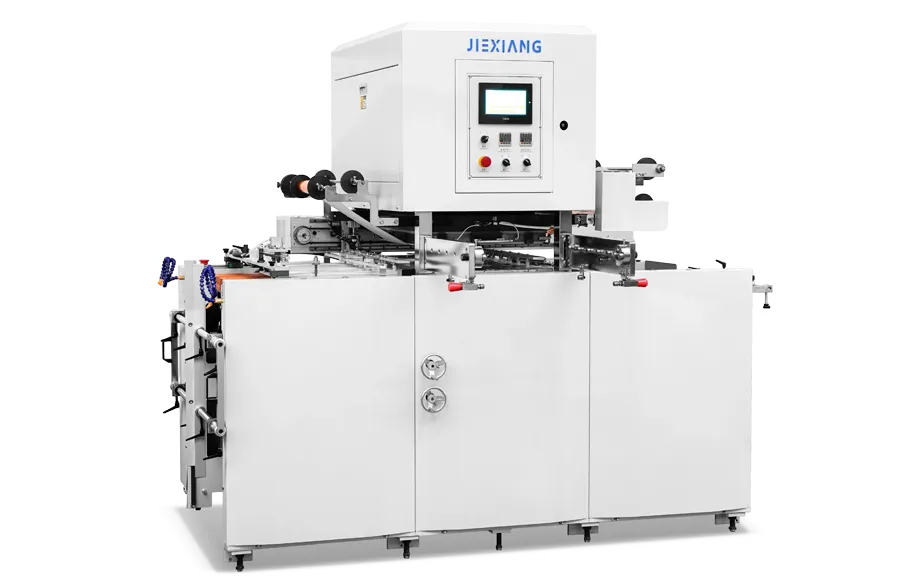
I’ve seen a flat foil stamping machine take 45 minutes to change dies because the heating plate had to be unbolted from the frame. In a shop doing 10 die changes a week, that’s 7.5 hours of lost production. Multiply by $100/hour shop rate = $750/week wasted. A JIEXIANG automatic stamper uses a slot-in die holder with quick-release pneumatics. See that die holder system in action – changeover is under 90 seconds, including temperature stabilization.
Comparing Technologies: When a Hot Stamper Loses to Digital or Pad Printing
Let me be honest because you deserve that. A Hot Stamping Machine is terrible for:
-
Photorealistic gradients (use digital toner foil or UV printer)
-
Tiny text under 4pt (pad printing is sharper)
-
Low-volume, multi-sku runs (setup time kills you)
But for metallic effects, high abrasion resistance (scratch tests prove foil stamping outlasts digital by 5x on cosmetic boxes), and tactile embossing—nothing beats thermal transfer. The metallic finish from a heated die actually bonds into the substrate, not just on top. You can rub it with acetone. Digital foils wipe off.
So don’t buy a hot stamper because it’s trendy. Buy it because your client requires gold foil on a wine label that survives an ice bucket. That’s the real use case.
The JIEXIANG Difference: We Build for Your Actual Substrate, Not a Brochure
Most suppliers ask: “What size machine?” We ask: “Send me a box of your products—good, bad, and rejected.” Because substrate thickness variation (±0.2mm is normal for molded plastics) kills rigid platen presses. Our floating head mechanism compensates for thickness changes during the stamping stroke. That’s not in the spec sheet; it’s in the results.
One client stamped braille dots on pharmaceutical cartons. Standard machines crushed the dots flat. We added a dual-stage pressure (light contact to locate, full pressure to transfer) and a heated silicone backing plate. Rejections dropped from 18% to 2%.
Final Checklist Before You Sign a PO
-
Heat uniformity variance – Ask for the report. Accept <5°C across the plate.
-
Die change time – Time it yourself during a demo.
-
Foil type test – Run your actual foil (metallic, pigment, holographic) on their machine.
-
Cycle consistency – Run 1000 cycles. Check first, middle, and last impressions.
If a supplier hesitates on any of these, walk away. You’re not buying a machine; you’re buying predictable output. JIEXIANG machines are designed for the 400th impression to look exactly like the 1st.